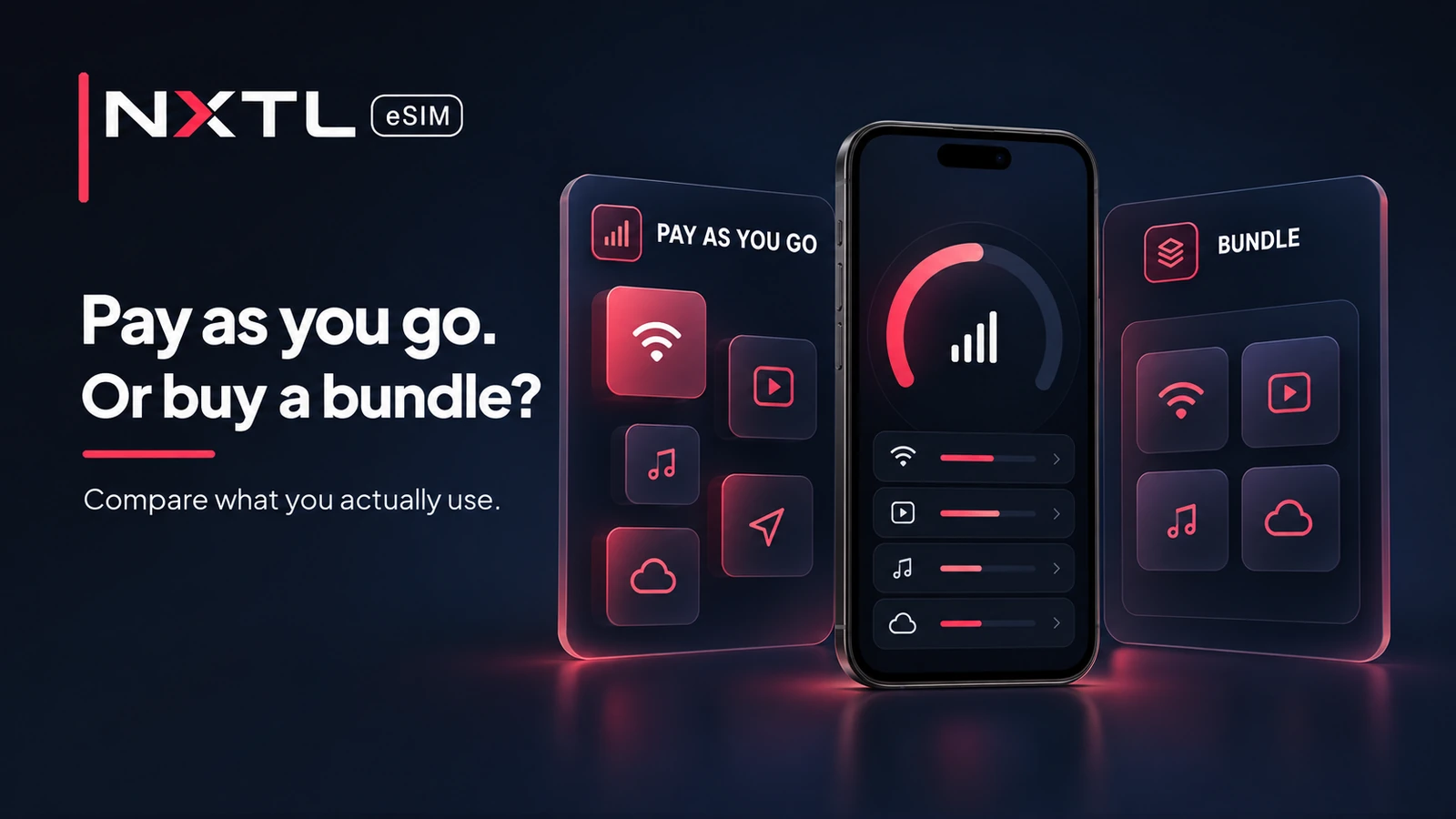
A pay-as-you-go eSIM charges for measured data usage, while a fixed bundle charges for an allowance with specified conditions. The better value depends on your destination, network, actual usage and what happens to the remainder. For a new PAYG customer, compare the initial purchase as well as the cost of the data consumed.
NXTL publishes this guide and sells PAYG connectivity. The calculations below explain how to compare the models; the hypothetical bundle is not a quote from a competing provider.
Three prices that answer different questions
An advertised rate per GB, a prepaid balance and a checkout total describe different parts of the purchase.
- Usage rate: the price applied to measured data on the connected network.
- Usable balance: money available to pay those charges.
- Initial payment: everything you pay to obtain the eSIM and its included balance.
At verification on 15 October 2026, the USD NXTL Global eSIM offer showed this breakdown:
| Component | USD amount | What happens to it |
|---|---|---|
| eSIM/setup component | $1.99 | Pays for the reusable profile and service setup |
| Included usable balance | $10.00 | Available for eligible data usage |
| Total initial payment | $11.99 | The amount paid upfront for one eSIM |
The $10.00 is included in the $11.99. Adding the two would count the same credit twice. Likewise, saying a first trip “costs $0.71” can be misleading if the customer must first pay $11.99 to obtain the service.
The standard consumer purchase has no monthly subscription. After the included balance is used, top-ups fund the same account. Check the amount credited and total payable at checkout; currency conversion or charges from your payment provider may affect your own outlay.
Calculate usage cost before comparing offers
For one network at an unchanged rate:
Estimated usage cost = data used in GB × displayed price per GB.
For several networks or destinations, calculate each part separately and add the results. A starting rate is not a promise that every partner in the country has that price.
NXTL’s pricing directory says usage is charged proportionally in 1 KB increments. The public per-GB figure is a comparison rate, rather than a requirement to purchase a whole gigabyte. The examples here use rounded displayed rates, not an attempted reconstruction of the underlying billing ledger.
Background traffic counts too. Opening a map, uploading a photo, receiving a file and letting a laptop synchronise all contribute to measured usage. “Pay only for what you use” includes traffic generated by applications without a separate tap on the screen.
Worked example: light, moderate and heavier use in France
Assume the phone stays on Free in France, displayed at $0.71/GB on the France destination page when checked on 15 October 2026. Assume an opening usable balance of $10.00, no other devices using the account and no unrelated traffic. The usage levels are planning scenarios, not measured traveller averages.
| Scenario | Data consumed | Formula | Estimated data charge | Balance left from $10.00 |
|---|---|---|---|---|
| Light | 1 GB | 1 × $0.71 | $0.71 | $9.29 |
| Moderate | 5 GB | 5 × $0.71 | $3.55 | $6.45 |
| Heavier | 12 GB | 12 × $0.71 | $8.52 | $1.48 |
A new customer pays $11.99 upfront in each scenario, with no further top-up needed under these assumptions. The data charges come out of the included $10.00; they are not charged again on top of that payment.
For the moderate example, the arithmetic can be reconciled as $11.99 = $1.99 setup + $3.55 consumed balance + $6.45 remaining balance. That describes where the payment went. It does not turn the remaining balance into a cash refund or reduce what left your bank account.
Actual deductions can differ slightly because the displayed rate is rounded, usage is metered in smaller units and the phone may use another network. Check current rates and your account records rather than treating these estimates as an invoice.
Put a hypothetical bundle beside the same usage
Now imagine a 15 GB bundle costing $8.00 and valid for 30 days, covering the same destination and permitting the same intended hotspot use. Assume no extra setup fee, no rollover and no renewal. This is deliberately invented arithmetic, not a currently available offer.
| Actual use during validity | Hypothetical bundle payment | PAYG consumption at $0.71/GB | New NXTL customer’s initial payment |
|---|---|---|---|
| 1 GB | $8.00 | $0.71 | $11.99, with $9.29 credit left |
| 5 GB | $8.00 | $3.55 | $11.99, with $6.45 credit left |
| 12 GB | $8.00 | $8.52 | $11.99, with $1.48 credit left |
For a customer who already has a working NXTL profile and funded balance, these examples show a lower consumption charge for PAYG at 1 GB and 5 GB. At 12 GB, the hypothetical bundle is lower: $8.00 rather than $8.52. An already-funded account still spends real prepaid value when data is used.
For a new customer buying only this trip, the bundle requires less cash upfront in all three rows. NXTL retains unspent credit for later eligible usage while the account stays active. Its value depends on whether you will use it; keeping credit and receiving money back are different outcomes.
The comparison changes if the real bundle is smaller, more expensive, expires earlier, excludes a stop or has different tethering rules. Compare the specific offer you can buy, rather than transferring these hypothetical results to a brand name.
Find the break-even point, then check the cash requirement
Ignoring setup, a bundle costing $8.00 breaks even with a $0.71/GB usage rate at $8.00 ÷ $0.71 ≈ 11.27 GB. Below that level, PAYG consumption is lower; above it, the assumed bundle is lower until its 15 GB allowance runs out.
If you allocate the entire $1.99 setup component to a first trip, the comparison becomes $1.99 + ($0.71 × usage). It reaches $8.00 at approximately 8.46 GB. This is a cost-allocation calculation; the new customer’s cash requirement remains $11.99 while the included balance covers usage.
Neither threshold proves which product wins for future travel. Rates can change, unused bundle data may or may not carry over under a particular product, and retained account credit may be spent in a differently priced destination. For a known return trip, calculate both journeys rather than assuming the first trip represents the year.
What you give up and keep with each model
A fixed bundle can make sense when your usage is predictable and you expect to consume most of its allowance within validity. Confirm what happens at the limit: a top-up, a stopped connection or another charging rule. A modest package may meet your needs without buying the largest option.
PAYG can suit uncertain or intermittent use because spending follows recorded traffic. You still need a budget. Review the rate before connecting, monitor the first day’s usage and top up while you have a working connection. NXTL also documents optional account and eSIM spending limits in its help centre; they act on recorded usage and are not an instant, exact cut-off.
NXTL has no fixed bundle allowance, separate NXTL hotspot bundle or daily high-speed allowance followed by a scheduled NXTL usage-triggered slowdown. Data remains paid and balance-funded. Network conditions, device support and the service terms’ network-management provisions still apply. These distinctions do not make it an unlimited-data plan.
Estimate your own usage without borrowing an average
Start with a similar day of your own mobile data. Check the counter’s reporting period, then adjust for activities that will change: work calls, uploads, navigation or sharing with a laptop. A day mostly on hotel Wi-Fi is a different budget from a day of mobile work.
Our 2026 usage study provides context about varied account totals. Its methodology explains that accounts can include several eSIMs and were not necessarily active throughout the window. Those records are not measured requirements for a complete holiday, and the study does not measure purchased or expired competitor bundles.
For named-provider research, use the existing travel eSIM comparison and verify its dated quotations against the exact current offer. The arithmetic in this guide does not replace a current destination-specific comparison.
Two final buying questions
Does unused balance buy the same amount of data next year?
Not necessarily. Standard unused NXTL balance remains available while your account stays active, subject to account terms. The amount of data it buys follows the applicable future rate, rather than a permanently reserved number of gigabytes.
Should I add enough credit for every possible download?
Plan for arrival and likely use, then learn how topping up works before you run low. Large backups or entertainment downloads can wait for suitable Wi-Fi. If your trip involves sustained heavy mobile usage, compare an appropriate high-volume bundle too.
Use the live pricing planner with your destinations and likely data. Check both the amount you must pay today and the prepaid value you expect to consume.
Related reading: keeping one eSIM for future trips, what “no expiry” covers, and hotspot and laptop use.