
You’re at the airport gate. Your boarding pass is ready, your hotel address is saved, and one last question pops up: What if I run out of data?
You’ll need Google Maps. A WhatsApp message when you land. An Uber from the airport. Maybe a few restaurant searches along the way.
So a 10 GB package starts to feel sensible. Perhaps 20 GB, just to be safe.
Buying a buffer is understandable. Nobody wants to hunt for Wi-Fi with a suitcase in one hand and a taxi driver waiting outside.
But before buying the bigger package, ask a different question: How much of it will I actually use—and what happens to the rest?
We looked at real NXTL network usage to put some evidence behind that question. What we found makes a good case for planning around your own habits rather than one supposed “average traveller.”
82%
of active accounts recorded under 5 GB in the recent 30 days, 11 September–10 October 2026.
52%
of those accounts recorded under 1 GB. The public median is a normalized index, not a gigabyte total.
9%
of accounts drove 71% of recorded volume in that same 30-day view.
What our real-world eSIM usage showed
Our study covers recorded NXTL usage from 14 July to 10 October 2026, roughly 88 days. Each account’s total combines its included eSIMs. Some accounts were active only briefly; these figures are account totals, not measured data needs for a complete holiday.
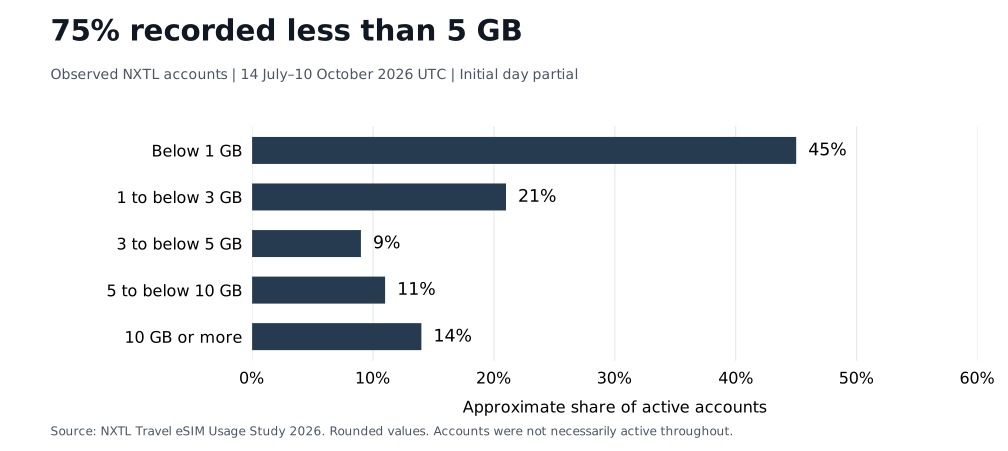
Here’s the breakdown, rounded for publication:
| Recorded usage over the study window | Share of active accounts |
|---|---|
| Less than 1 GB | 45% |
| Less than 3 GB | 66% |
| Less than 5 GB | 75% |
| 10 GB or more | 14% |
The “less than” rows overlap: accounts below 1 GB are also below 3 GB and 5 GB.
Nearly half of the active accounts recorded less than 1 GB. Three out of four recorded less than 5 GB.
Picture four accounts from the study: three sit below the 5 GB mark. That tells you something useful about how varied mobile-data use can be. It doesn’t tell you what to buy for your next trip—you might use your connection very differently.
The recent 30-day view tells a similar broad story: 82% of active accounts recorded less than 5 GB between 11 September and 10 October. That shorter window sits inside the longer study, so it’s another view of the records rather than a separate survey.
Why the “average traveller” can steer you wrong
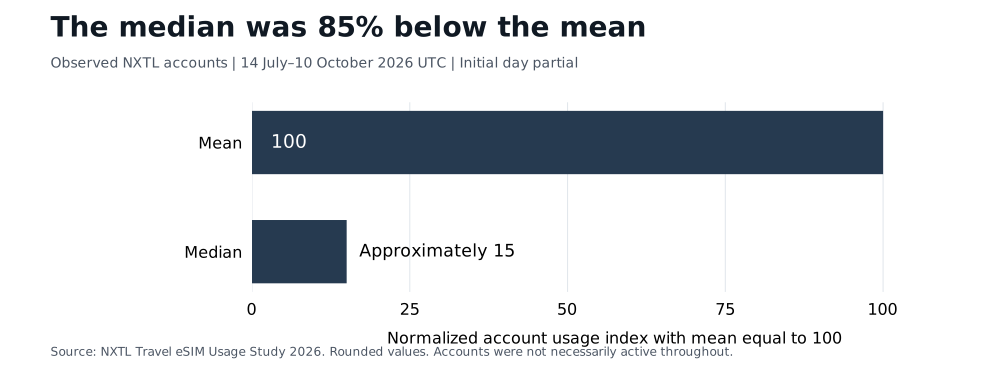
The smaller group using 10 GB or more accounted for 82% of all recorded data volume in the main study.
That pulls the average upward. Our average account total was nearly seven times the total of the middle account—the one with half the accounts above it and half below it.
Think of splitting a restaurant bill when one person orders several extra courses. The average spend per person can be perfectly correct while giving everyone else a poor idea of what their own dinner costs.
Data works much the same way. Someone sharing a connection with a laptop or watching video every day can have very different needs from someone using maps and messages between hotel Wi-Fi sessions.
Our records don’t identify the activities behind the heavier accounts. What they do show is that one average hides a wide range of use.
Your shopping list should come from your plans: directions and messages, social scrolling, video calls, laptop work—or some combination of those.
The hidden cost: unused data can have a deadline
Suppose you buy a 10 GB package, use 3 GB, and return home with 7 GB remaining.
If the package expires before you use the rest, those remaining gigabytes stop being available. You paid for an allowance you didn’t fully use.
Airalo’s help centre says remaining data cannot be used after the validity period. Saily’s help centre likewise says the plan and its remaining data expire when validity ends.
The deadline depends on the package. It might be seven days, 30 days or longer. Check when the timer starts, too; installation and first connection don’t always mean the same thing.
Keeping the eSIM installed doesn’t automatically keep an expired package’s data. A reusable profile and a reusable balance are different things.
A fixed package can still be good value, especially if you expect to use plenty of data. The point is to compare the cost for your likely use—not assume the biggest allowance is the safest purchase.
Fixed bundles vs. pay-as-you-go eSIMs
With a fixed bundle, you choose an allowance and validity period before using it. With NXTL, you buy prepaid account balance, and data charges come out of that balance as you use the service.
| What matters | Fixed bundles such as Airalo/Saily packages | NXTL pay-as-you-go |
|---|---|---|
| What you buy | A set allowance for a specified period | A reusable eSIM with usable account balance; later top-ups add credit |
| How data is charged | You pay the package price, even if some allowance remains unused | Recorded usage draws from your balance at the applicable network rate |
| What happens to what’s left | Remaining allowance expires when that package’s validity ends | Unused standard balance does not expire, subject to account terms |
| If your plans change | Check whether the package still covers your dates and destinations | Keep your balance for later use in supported destinations |
| Keeping the same eSIM | Profile reuse and top-ups depend on the product | Keep the same profile installed on your compatible device |
| What to compare before buying | Package price, allowance, validity and top-up conditions | Upfront purchase, usable balance, destination rates and account terms |
This compares the named fixed-bundle model with NXTL’s standard PAYG service, not every product those providers offer. Smaller fixed allowances exist, and the lowest-cost option depends on your destination and usage.
How much eSIM data do I really need for a trip?
Start with what you’ll do on mobile data, how long you’ll be away, and what you can move to Wi-Fi. Maps, text messages and ride bookings need a different budget from daily video streaming or laptop hotspot use.
Our study cannot give you a universal “GB per holiday” number. You can make a more useful estimate from your own phone.
1. List what you’ll actually do away from Wi-Fi
Will your eSIM mostly cover directions, WhatsApp and finding a place for lunch? Or will you be uploading videos, taking work calls and sharing data with a laptop?
Think about the moments when connectivity matters most: arriving at the airport, meeting your host, changing a train reservation or getting back to your hotel.
2. Check a day of your own mobile usage
Open your phone’s mobile-data or cellular settings. Check the reporting period, or reset the counter before a test day, so you aren’t reading months of accumulated use.
Try a day that resembles your planned trip. Then multiply that day’s use by your trip length, allowing extra for busier days.
For example, 200 MB a day over seven similar days works out to about 1.4 GB before a buffer. That’s a planning example, not a finding about travellers in our study.
If your holiday will involve far more video, uploads or hotspot use than the test day, increase the estimate accordingly.
3. Move the bulky tasks to Wi-Fi
Downloading a film, backing up holiday photos and updating a laptop don’t usually need to happen while you’re walking around town.
Save those jobs for a reliable connection you trust. Keep mobile data available for the things you need while you’re out.
4. Make topping up part of the plan
Check how adding more data or balance works before you need it. With NXTL, review your balance and top up before it runs out; if you’ve already lost your data connection, you’ll need Wi-Fi or another connection to complete the top-up.
That gives you a practical backup plan without making a large data allowance your only safety net.
Five easy ways to make your travel data go further
- Download maps before departure. Google Maps supports offline downloads where available, but offline walking, cycling and public-transport directions aren’t available. Keep data ready for those features and live information.
- Download entertainment over Wi-Fi. Save playlists, podcasts and videos beforehand where your apps allow it.
- Keep photo backups and app updates on Wi-Fi. Your phone can use data even while it’s sitting in your pocket.
- Switch on data-saving settings. For example, iPhone’s Low Data Mode reduces background network activity. Review video quality and autoplay in your apps too.
- Watch connected devices. A laptop using your hotspot can start downloads or updates you weren’t expecting. Check its settings before sharing your connection.
For the device details, see Google’s offline Maps guide and Apple’s Low Data Mode guide.
What happens to unused eSIM data?
It depends on what you bought. Unused allowance in a fixed bundle expires when that package’s validity ends. With NXTL’s standard pay-as-you-go service, unspent account balance stays available for future use under the account terms.
That difference matters when your plans are unpredictable. Hotel Wi-Fi might work better than expected. You might spend more time hiking and less time scrolling. Your trip might end with much of your planned data still untouched.
With NXTL, that unspent balance can remain available for your next supported trip or a moment when you need backup connectivity.
Keep your balance for the next trip with NXTL
You shouldn’t have to use more data just to feel you got your money’s worth.
NXTL gives you one reusable eSIM profile, pay-as-you-go data and no monthly subscription. Keep it installed on your compatible device, add balance when needed, and use it across supported destinations.
Your standard balance has no expiry date under NXTL’s account terms. The terms also cover account suspension and closure, including long-term inactivity. There’s no country-bundle countdown telling you to spend the remainder before your holiday ends.
You still pay for the eSIM setup and the data you use, and rates depend on the network you connect to. What you don’t spend on this trip stays in your balance for later use.
Start by checking your destination and expected usage. Then choose whether NXTL fits the way you travel.