A business eSIM can connect travelling employees, become part of a customer offer, or provide mobile data for compatible equipment. NXTL brings those uses into one prepaid business account: issue through the portal, automate through the API, and review usage against a shared balance. The right starting point is a specific workflow, not a promise that every business needs the same plan.
This guide explains 36 practical ways to use that model. The examples are proposed operating patterns, not customer case studies or guaranteed savings. NXTL is the publisher and service provider. Product capabilities and public documentation were reviewed on 16 October 2026.
What does eSIM for business mean in practice?
An eSIM is a digital cellular profile installed on a compatible device. For a company, its value extends beyond replacing a plastic SIM: someone must fund connectivity, assign it, deliver installation details, resolve problems and reconcile the cost. A business platform gives those tasks a repeatable home.
With NXTL, the business account holds prepaid balance used by its issued eSIMs at applicable rates. An operations team can use the portal without developers. An approved integration can issue and manage lines from an existing booking, employee, support or asset system. The portal and API serve the same business account rather than separate inventories.
The NXTL for Business page is the application and product overview. The examples here help you choose what to build around it.
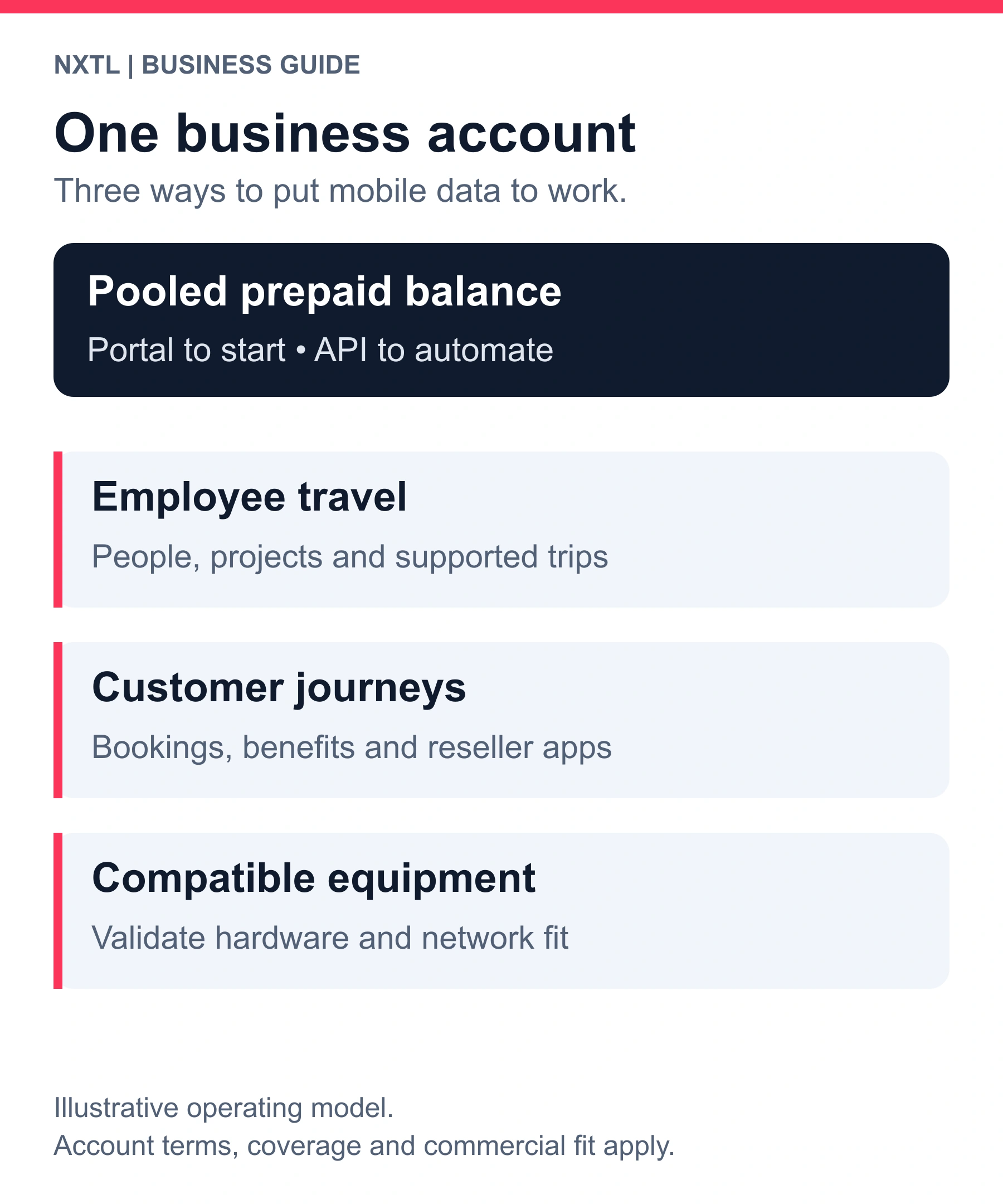
One account, three operating patterns. Your own application can organise teams and customers; a pooled balance is not a promise of separate regulated customer wallets.
Choose the commercial model before writing code
| Model | Who owns the customer journey? | How NXTL fits | What to settle first |
|---|---|---|---|
| Internal company connectivity | Your travel or IT team | Issue and manage employee or equipment lines centrally | Funding, supported devices, destinations and responsibility for support |
| Embedded benefit or paid add-on | Your app, booking site or membership | Provision data within an existing customer journey | Entitlement, pricing, refunds, customer disclosure and delivery |
| Reseller integration | Your distribution business | Use an approved business/API arrangement to supply connectivity | Resale permissions, commercial rates, branding and support split |
| Affiliate referral | NXTL completes the referred retail transaction | Refer through the separate partner programme | Attribution and current programme terms |
Selling through your own app and referring a buyer to NXTL are different arrangements. The affiliate programme does not automatically define API reseller margins or wholesale pricing. Branded delivery, tailored volume pricing and invoiced billing are matters for commercial agreement, not defaults to assume from a public retail price.
1–4. Corporate travel, sales and project teams
1. Consultants working across several client markets
Issue a profile when an employee joins the travel cohort, then label it with a project reference. The traveller keeps that installed profile for subsequent supported assignments. Finance reviews usage against the company balance instead of collecting a new bundle receipt for every border. Connect the travel approval record to the line reference; keep personal itinerary details out of labels that do not need them. Measure purchasing time, support tickets and data cost per travelling day.
2. Sales teams attending overseas meetings
Prepare connectivity before departure so the salesperson can use maps, messaging, CRM and ride-hailing after arrival. The employee selects the NXTL line for mobile data while retaining the usual number where their device supports that arrangement. Their home operator may still charge for calls, SMS or roaming left enabled on the other line. A travel administrator can provide one setup checklist with the trip confirmation and review usage after the meeting rather than treating mobile data as an untracked expense.
3. Engineers, auditors and installation teams
Tie an eSIM to an engineer or assignment so field-service coordination, document retrieval and hotspot use have an identifiable owner. A laptop can connect through a compatible phone hotspot; an eSIM-capable router is another device-specific option. Estimate the expected workload, including video calls and software downloads. The first pilot should include the actual corporate VPN and customer systems because network reachability matters as much as a signal indicator.
4. Relocating employees and short-term assignments
Offer an arrival connection between landing and the establishment of local long-term service. HR can include installation steps in an onboarding pack and the helpdesk can see which line belongs to the assignment. Treat the eSIM as an arrival resource or ongoing travel option according to the agreed use. Standard data service does not itself provide the local telephone number an employee may need for banking or official registrations.
5–8. Travel agencies, booking platforms and concierge services
5. A travel agent arranging a multi-country itinerary
Attach connectivity to the itinerary checklist rather than asking customers to research a different product at every stop. Confirm supported destinations and device compatibility before offering it. A portal pilot can establish the delivery and support process before an API integration is built. Use the booking reference to reconcile issuance, then decide whether connectivity is included in the service or sold as a clearly described add-on.
6. An online travel agency adding eSIM fulfilment
A confirmed booking can trigger a server-side request to NXTL. The platform records the asynchronous job and delivers installation details when provisioning succeeds. A cancelled booking should move into an explicit review workflow; cancelling a flight does not automatically reverse an issued eSIM or refund consumed data. Keep the connectivity item distinguishable in your own order history so support can resolve the right product without interpreting a passenger-name record as proof of provisioning.
7. Tour operators managing groups
Issue a cohort for a tour departure and track every requested line individually. Send each participant their own installation instructions and give the tour leader a clear support route. Some participants will use much more data than others; a common business balance accommodates uneven consumption without assuming identical personal allowances. If the operator wants to sponsor a certain amount per guest, that entitlement needs a documented policy in its own product and support process.
8. Premium concierge and disruption assistance
Offer practical mobile access when a guest is rebooked, changes destination or arrives without working connectivity. The trigger might be a support case rather than the original sale. Record who authorised the issuance and how the benefit is funded. Keep an installation path that works while the guest still has airport, hotel or other internet access: an eSIM cannot normally download its own profile before any connection exists.
9–12. Airlines, airports and aviation operations
9. Airline passenger arrival connectivity
An airline can explore a data add-on or loyalty benefit for use after landing. Integrate the offer into a post-booking email or app journey, with activation guidance before departure. The value is connected arrival: transport, accommodation messages and maps in supported destinations. This use case does not depend on providing onboard connectivity and should be sold separately from any aircraft Wi-Fi or cellular service.
10. Airline crew on international layovers
Associate lines with crew members or operational assignments and provide a repeatable layover setup. Crew scheduling or an internal portal can become the trigger once the manual process is understood. Keep scheduling and personal data exposure proportionate to what connectivity support requires. A profile remaining useful for later supported trips reduces repeated procurement; it does not make every destination or aircraft an available network.
11. Irregular-operations and passenger-care teams
Ground handlers and assistance teams may need mobile access while coordinating rebooking, transport or accommodation away from a fixed desk. An operational line can support messaging and permitted business applications on compatible equipment. Test the actual airport and carrier environment, including indoor coverage. Measure time to restore working access during a disruption; do not promise passenger safety systems or continuous connectivity from a standard roaming service.
12. Participating in-flight mobile networks
NXTL's coverage information includes participating aircraft using AeroMobile AS. This is a separate availability and tariff question from ordinary terrestrial roaming. An aviation business should confirm the specific onboard network, active service, passenger-device rules and published rate before advertising it. Do not turn “participating aircraft” into “all flights,” or position NXTL as a replacement for an airline's own installed connectivity infrastructure. Check the current coverage list.
13–16. Cruise, ferry and marine travel
13. Cruise guests exploring ports
Provide a reusable travel-data option for supported ports and shore excursions. A guest app can surface instructions alongside the itinerary and show when terrestrial coverage should be checked. Distinguish shore use from service at sea, where network availability and rates can be different. Help guests make an informed network choice before data starts flowing rather than presenting one blended “cruise data” claim.
14. Cruise crew and shore operations
Crew welfare programmes or port-operation teams can explore centrally funded connectivity on compatible devices. Identify the line owner and support route, and explain any company-sponsored entitlement separately from NXTL's charging model. Repeated port visits are a useful pilot pattern because the business can compare the same devices and workflows over several calls. A crew programme still needs a clear commercial and privacy arrangement.
15. Ferry operators and participating maritime networks
NXTL lists participating passenger vessels equipped with Telenor Maritime AS. Operators should validate route, ship, network activation and current maritime pricing before building an onboard offer. Availability is not a promise of ocean-wide coverage, satellite service or coverage on every vessel. A booking platform can still offer shore connectivity even when no onboard network is supported; make those two benefits distinguishable to customers.
16. Yacht charter and marine concierge services
A charter company can prepare guests for supported coastal destinations and give staff a mobile-data option ashore. Consider a compatible router for a specific approved setup, but test it with the real hardware and route. Keep onboard maritime tariffs and terrestrial rates visible. Standard roaming data should not be the sole connection for navigation, distress communications or other critical marine functions.
17–20. Fintech, memberships and customer benefits
17. A banking app offering a travel benefit
A bank can explore connectivity as a cardholder benefit within its own app. Its backend checks eligibility, creates an internal entitlement and calls NXTL only after the customer claims the benefit. Track the bank's entitlement and the NXTL provisioning result separately so repeated taps do not issue repeated profiles. Agree who funds usage and who answers installation questions before describing the benefit as included in a membership.
18. Payment cards, wallets and premium accounts
A wallet or card programme can add a useful travel extra without becoming a mobile network operator. The commercial model might fund a benefit centrally or sell an add-on at a disclosed price. A common balance does not automatically create isolated prepaid wallets for every cardholder. If the product promises individual spending allowances, the partner must map those promises to the controls and reporting available in the agreed NXTL setup.
19. Membership clubs and loyalty programmes
Offer connectivity to customers who meet a membership condition or redeem a benefit. The club can show eligibility and instructions in its own interface while keeping credentials and issuance on its backend. Establish how renewals, repeated claims and existing installed profiles are handled. Measure benefit activation and repeat use rather than assuming every member will consume the same data or that a benefit automatically improves retention.
20. Travel insurance and assistance products
An assistance provider can explore mobile data as a support benefit when a traveller needs to contact the team or arrange transport. Define the service trigger, sponsored cost and escalation route. Connectivity is an operational assistance tool, not an insurance policy or a guarantee that emergency services can always be reached. The provider should approve the benefit wording and integration responsibilities within its own regulated product process.
21–24. Resellers, marketplaces and your own app
21. An existing eSIM reseller adding a PAYG option
A reseller can explore NXTL alongside fixed bundles rather than replacing every supplier. Present the difference clearly: actual usage debits a funded balance at applicable rates, while the reseller's own sale price and customer promise follow its commercial arrangement. Compare the whole economics—issuance, data, fulfilment and support—not just a headline cost per gigabyte. Apply for the business arrangement before treating retail pricing as a wholesale contract.
22. A branded travel-connectivity app
Your app can own browsing, entitlement, installation guidance and customer support while your server calls NXTL. The standard integration is server-to-server; putting a business API key in the mobile app is not the integration model. Branded delivery and commercial presentation need agreement, and device installation still follows the operating system's supported process. An API by itself does not grant silent installation or an unrestricted native installation entitlement.
23. A distributor using several connectivity suppliers
Keep NXTL as an approved option within a supplier-routing workflow. Your application can choose a commercial product based on the requirements it knows, then fulfil through the relevant supplier. NXTL's current public API does not document a complete destination/network price catalogue, so do not assume you can build a live multi-provider price comparison from an invented endpoint. Agree a supported pricing-data process where machine-readable rates are essential.
24. A marketplace or retail distribution channel
Provide connectivity through an approved business arrangement, with your order ID carried through fulfilment. Track the profile's delivery state, buyer instructions and after-sales ownership. Your storefront needs its own product description, tax treatment, payment handling and refund process. NXTL's API supports connectivity operations; it does not automatically supply your marketplace checkout, merchant-of-record service or customer-facing support organisation.
25–28. Hospitality, relocation and specialist arrivals
25. Hotels and serviced accommodation
Send an optional arrival connection with a booking or check-in journey. It can help guests contact the property and navigate after leaving Wi-Fi. Decide whether the property sponsors the data or sells an add-on, and give guests installation instructions before arrival. A front-desk portal pilot is often enough to learn the workflow before connecting a property-management system through a custom integration.
26. Relocation companies and property services
Bundle practical connectivity into an arrival pack for a supported destination. The relocation coordinator can issue after the assignment is confirmed and connect the line to a case reference. Separate mobile-data assistance from local voice-number services or other tasks the client needs after moving. Explain who pays for ongoing data once any sponsored arrival benefit ends.
27. Universities, exchange programmes and education agents
Help incoming students get a data connection for their first days in a supported market. Batch issuance and a clear welcome guide can simplify distribution, while a support contact handles device and installation questions. Use only the student information necessary for eligibility and delivery. This is a possible arrival programme, not an assertion that NXTL has existing university contracts or that it replaces a student's longer-term local service.
28. Medical-travel and appointment coordinators
A coordinator can help an international visitor access maps, transport and ordinary messaging around appointments. Treat this as a convenience within the travel journey. Avoid placing sensitive health details in eSIM nicknames, references or general connectivity logs. A standard data product is not a medical communications system and should not carry a promise of uninterrupted clinical or emergency access.
29–32. Field operations, events and business backup
29. Logistics and cross-border field teams
Connect compatible phones, tablets or approved equipment used for dispatch, forms and customer updates. Associate each line with an asset or operational reference and test the actual countries, radio bands and applications. A multi-country workflow reduces repeated purchasing tasks, but roaming rules and longer-term deployment suitability still need review. Do not assume a travel eSIM is automatically an industrial low-power IoT service.
30. Events, touring crews and media production
Prepare temporary cohorts for venue setup, guest coordination and production support. The portal can issue and label lines before the event; an API can automate repeat deployments when the pilot works. Decide which tasks need cellular data and which belong on venue connectivity. Large media uploads can be metered usage too, so model their cost and available uplink capacity instead of treating “no FUP” as unlimited free bandwidth.
31. Compatible equipment and mobile sites
Explore cellular access for an eSIM-capable router, laptop, tablet or telemetry device when the hardware and intended use are supported. Test profile installation, APN, roaming and reachability before building a fleet. If the project needs a static public IP, inbound connections, private APN, specific IoT provisioning standard or a service-level guarantee, obtain explicit confirmation. Those requirements are not established merely by the existence of a business API.
32. Backup for a shop, office or temporary location
A compatible phone hotspot or router can provide a backup path for selected tasks when the primary connection fails. Define the tasks first: messaging, a booking system or a modest operational workload may have different requirements from video production. Test failover and recovery, power and local coverage. Another brand does not necessarily mean an independent radio network; assess the actual underlying network when resilience is the goal.
33–36. Further operating patterns worth piloting
33. NGOs, relief teams and visiting project staff
Issue and track connectivity for supported locations before a deployment, with an operational owner and a documented fallback. A common account can make replenishment and reconciliation easier across short assignments. Verify coverage and restrictions for the specific destination. Standard roaming data should complement, rather than replace, the communications plan appropriate to difficult or safety-critical environments.
34. Adventure operators and outdoor experience businesses
Help guests and guides stay connected in supported locations around an itinerary. Explain where network coverage is uncertain and supply offline information as well. The useful integration may be a booking email and a portal-issued profile rather than a large software project. Track the support workload and clearly separate cellular coverage from satellite tracking or rescue communications.
35. Coworking, retreats and mobile professional communities
Offer a useful travel-data option when members move between supported locations or work away from a shared office. Members can use compatible phone hotspots for laptops where appropriate. The organiser must decide whether connectivity is optional, sponsored or resold. The programme becomes more credible when it describes a clear entitlement and support route rather than a vague “unlimited work anywhere” promise.
36. Vehicle rental and mobility services
A rental or mobility company can offer connectivity to travellers for supported use, or test approved connected equipment in its own operations. Keep guest-phone delivery separate from embedded-vehicle requirements: a vehicle's existing eSIM may not accept a third-party travel profile. Validate hardware, installation rights and network requirements before putting connectivity into an automated rental workflow.
Which NXTL capabilities support these workflows?
| Capability | What the business can do | Practical implementation detail |
|---|---|---|
| Pooled prepaid balance | Fund a common business resource | Reconcile usage and funding separately; fees and rates depend on the account and service |
| Portal and REST API | Start manually and automate repeat tasks | API access requires an approved business account |
| Single and bulk issuance | Prepare one line or a larger cohort | Documented bulk issuance accepts up to 1,000 per request, subject to available balance, quota and permissions |
| Labels and references | Connect a line to a person, project, order or asset | Use internal references without unnecessary personal information |
| Lifecycle management | Suspend, resume, terminate or exchange a profile | Confirm permissions and the operational effect before automating irreversible actions |
| Usage and ledger reporting | Reconcile activity by line and period | Usage records can arrive after network activity |
| Thresholds | Notify or suspend according to configured rules | These are company controls, not NXTL fair-use limits or instantaneous spending guarantees |
| Network preference | Use supported policies such as cheapest or best coverage | Validate the actual networks and applicable rates in the destination |
| Scoped keys and signed events | Connect systems with controlled permissions | Keep secrets on the server and process events reliably |
The API documentation provides the technical contract. Our integration guide explains the application architecture, fulfilment states and operational decisions behind an app or booking integration.
How does this help control roaming costs?
The opportunity is to replace fragmented purchasing with measured consumption and a consistent operating process. Whether the result is cheaper depends on the destinations, actual usage, issuance costs, other fees and the alternative the business would otherwise buy. A company with an already-included roaming allowance may see little direct data-cost saving; another may reduce both unused purchases and administrative work.
Unused standard prepaid balance remains available under the account terms. That retained value is different from a refund, a cash saving already realised or a promise that every device stays active indefinitely. For a worked comparison, see the business roaming-cost and backup playbook.
Does NXTL impose a fair-use data cap?
NXTL has no usage-based FUP on its standard metered PAYG data service. NXTL does not impose a daily or monthly fair-use allowance, or slow a line merely because it has used more paid data. More usage is charged at the applicable rate. This does not mean free unlimited data or a guaranteed network speed. Speeds and availability depend on the device and network; a business can choose its own usage controls. See the current service terms.
What should a first business pilot include?
Choose one team, route or customer benefit. Identify the supported devices and markets, expected usage, funding owner, fulfilment trigger and support owner. Agree the commercial arrangement and begin with a contained rollout. A pilot should answer whether the service connects reliably in the intended environment, whether fulfilment completes, what the actual cost is and how much support it takes.
For an app, test repeated requests, provisioning failure and delayed events as well as successful issuance. For backup, test an actual failover and recovery. For resale, test the full order-to-installation and after-sales journey. A good pilot produces a repeatable operating procedure, not just one successful speed test.
Questions businesses ask before integrating
Do we need developers from day one?
No. Use the business portal for a manual pilot. Add the REST API when an established workflow benefits from automation.
Can another eSIM reseller use NXTL?
An existing reseller can apply for an approved business/API arrangement. Confirm resale, rates, branding, support and customer-facing obligations as part of that arrangement; the retail offer and affiliate programme are separate models.
Can our customers remain inside our own app?
Your app can present the offer, entitlement and installation guidance while your backend communicates with NXTL. The operating system still controls supported eSIM installation flows, and branded delivery is subject to the agreed setup.
Can the same setup connect staff and customers?
The business platform supports employee, customer and compatible-device use patterns. Your organisation must define ownership, permissions, funding and customer entitlements for each group.
Are airline and cruise use cases limited to onboard data?
No. Arrival, layover, port and shore connectivity are distinct opportunities. Participating aircraft and maritime networks are separate coverage and tariff questions that must be checked before advertising onboard service.
Where should we start?
Apply for NXTL Business with your use case, markets, device types, expected volume and preferred portal/API workflow. Ask for the commercial and technical fit for that concrete first rollout.