A business can reduce roaming waste by matching mobile-data purchasing to real usage, keeping unused prepaid value available and managing connectivity centrally. Whether NXTL costs less than your current arrangement depends on destinations, consumption, issuance charges and operational work—not a universal saving percentage. Backup connectivity adds another question: what work must continue when the primary connection fails?
This playbook gives finance, travel and IT teams a practical evaluation method. Its worked numbers are deliberately hypothetical USD inputs, not NXTL rates, customer results or a business quote. NXTL is the publisher; public product information was reviewed on 16 October 2026.
Start with the cost you actually incur today
Collect the mobile-data costs attributable to the intended group and route. Your comparison might be against home-operator roaming charges, daily passes, local SIM procurement or fixed travel bundles. Identify what the existing service already includes before assuming an eSIM is cheaper.
Count the relevant fees, taxes and currency conversion consistently. Include time spent buying, distributing, supporting and reconciling connectivity only if you can measure it or clearly state an assumption. Do not present all home-plan cost as avoidable if the company will keep that plan for ordinary calls, SMS and domestic service.
The NXTL business model uses a pooled prepaid balance and supports portal or approved API operation. Public consumer starter pricing is not a wholesale rate card. Obtain the configured business issuance, exchange and data rates for the proposed rollout.
Use a consumption model and a cash model
There are two different views of the same pilot:
- Service consumed: actual data charges, issuance/exchange charges, other applicable fees and measurable administration.
- Cash funded: what you paid upfront, what has been consumed and what remains available in the business balance.
Unused standard prepaid balance can remain available for future supported use under the account terms. It is not automatically a realised saving, a cash refund or a monthly operating expense equal to the entire funding amount. Finance should apply its own accounting treatment while preserving the operational distinction.
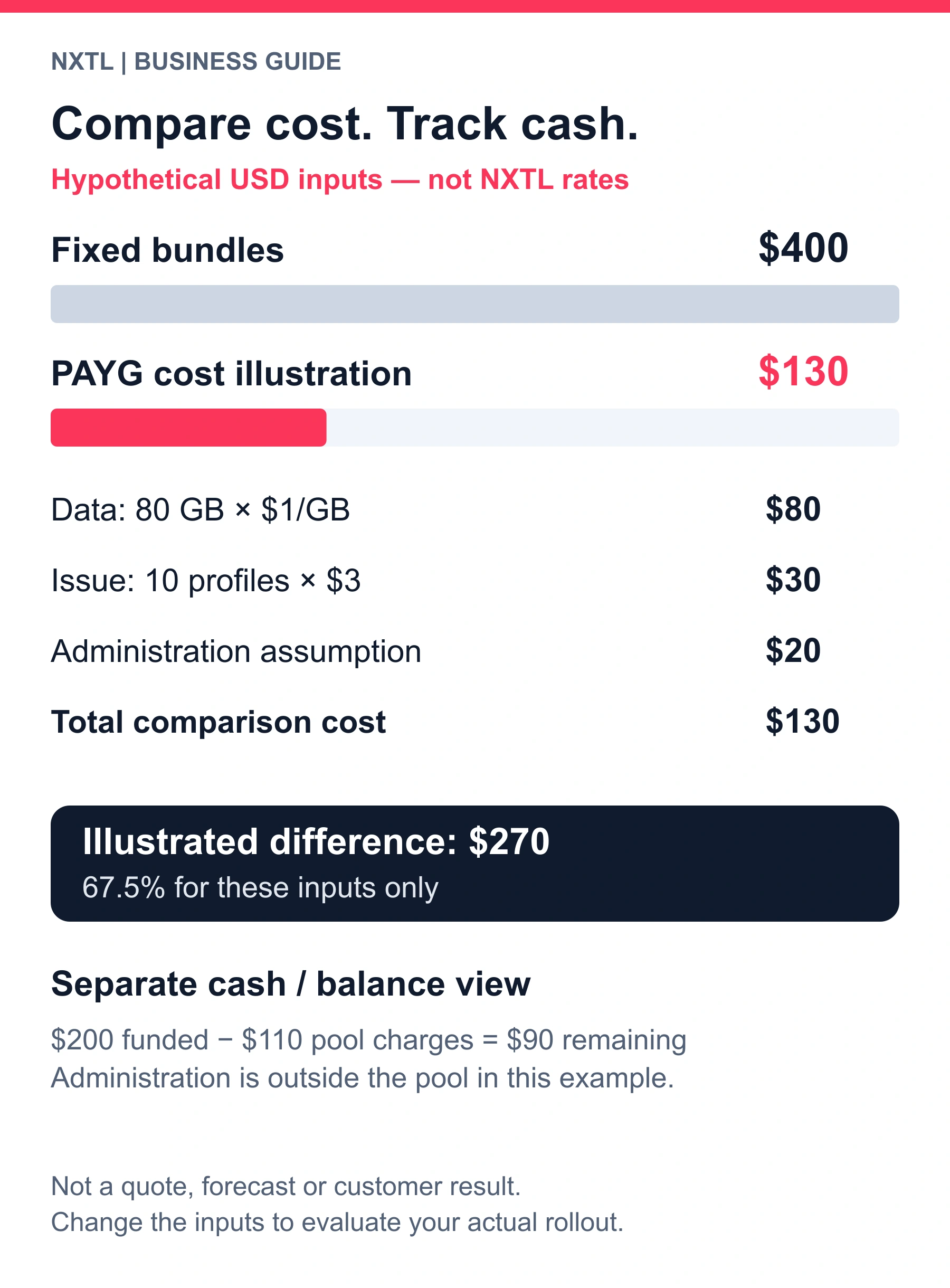
Hypothetical USD example only. The exact inputs and arithmetic are reproduced below; these are not NXTL business prices.
Worked example: 20 travellers with uneven usage
Assume 20 people each need a hypothetical fixed bundle costing $20 and including 5 GB. Across the cohort, actual data use is 80 GB. For the PAYG comparison only, assume $1 per GB, 10 newly issued profiles costing $3 each, and $20 of measured or assumed administration. These prices are chosen to make the calculation transparent; they are not quoted NXTL rates.
| Illustrative input or result | Calculation | USD or volume |
|---|---|---|
| Fixed bundles bought | 20 × $20 | $400 |
| Aggregate included data | 20 × 5 GB | 100 GB |
| Actual data consumed | Assumed measured cohort use | 80 GB |
| PAYG data cost | 80 GB × $1/GB | $80 |
| New-profile cost | 10 × $3 | $30 |
| Administration assumption | Explicit comparison input | $20 |
| Total illustrated PAYG cost | $80 + $30 + $20 | $130 |
| Difference against bundle spend | $400 − $130 | $270 |
| Difference as a share of bundle spend | $270 ÷ $400 | 67.5% |
The percentage is a property of these inputs, not a forecast. Aggregating 100 GB of bundled allowance also hides individual allocation: one person might exhaust their 5 GB while another hardly connects. Do not treat aggregate unused allowance as proof that every traveller's needs were met.
For the separate cash view, suppose the business funds $200 and the pool pays the example's $80 data and $30 issuance charges. The remaining balance is $90. The $20 administration assumption is outside that pool in this example. Cash paid is still $200; $90 is retained prepaid value, not a refund.
Find the point where your alternative becomes cheaper
For a simplified comparison with a uniform PAYG data rate, the break-even usage is:
(Alternative cost − issuance charges − other PAYG fees − administration) ÷ PAYG rate per GB.
Using the illustration, that is ($400 − $30 − $20) ÷ $1 = 350 GB. At 350 GB the simplified PAYG cost is $400. However, the hypothetical fixed bundles include only 100 GB in total. This threshold does not prove that those exact bundles can supply 350 GB for $400. Compare with an alternative that actually meets the usage requirement, including its top-ups or overage charges.
Change the rate to $5/GB while keeping 80 GB of consumption, $30 issuance and $20 administration: the illustrated PAYG total becomes $450, or $50 more than the $400 bundle purchase. This sensitivity is why destination and network rates belong in the decision. For several rates, sum usage multiplied by its applicable rate instead of using one convenient global average.
What can the business control?
| Control | Benefit | Important operating detail |
|---|---|---|
| Pre-trip device and coverage check | Avoid unsuitable purchases | Test the actual model, configuration and destination |
| Reuse an existing installed profile where appropriate | Reduce repeated setup | Device changes and deleted profiles need their own process |
| Label lines by owner or project | Make spend attributable | Minimise personal data in labels |
| Set threshold notifications | Prompt investigation | Network usage can be reported late |
| Configure a suspension rule where suitable | Limit ongoing exposure operationally | It is not a guaranteed instantaneous hard cap |
| Review background downloads | Reduce avoidable traffic | OS updates, backups and laptop sync can consume data |
| Review network policy and rates | Match the connection to the job | The lowest rate is not the only consideration for a critical workflow |
| Retain a funding buffer | Avoid preventable service interruption | Avoid representing a prepaid pool as a credit facility |
No FUP does not mean no cost
NXTL has no usage-based FUP on standard metered PAYG data: NXTL does not reduce speed merely because a line has consumed more paid data, or impose a daily fair-use gigabyte allowance. Data continues to be charged at applicable rates. Larger downloads therefore affect cost even when there is no NXTL fair-use slowdown.
Speeds and availability still depend on the local network, device and conditions. Your company may also choose its own notifications or suspension rules. Those chosen business controls are different from a provider-imposed FUP. The current terms explain the service policy.
Design backup around a specific task
A backup line is useful only if it can support the intended application when the primary connection fails. Define the minimum workload: opening bookings, messaging a team, sending a form or operating a compatible terminal. Test corporate VPN, authentication and any payment application requirements in the actual setup rather than assuming that basic web browsing proves compatibility.
A compatible phone hotspot may be enough for one laptop. A supported eSIM-capable router may suit a temporary worksite or a shared backup path. Confirm that the device can install the profile, supports the necessary radio bands and can be configured for the service. An embedded SIM already fitted by a device manufacturer is not automatically open to third-party profiles.
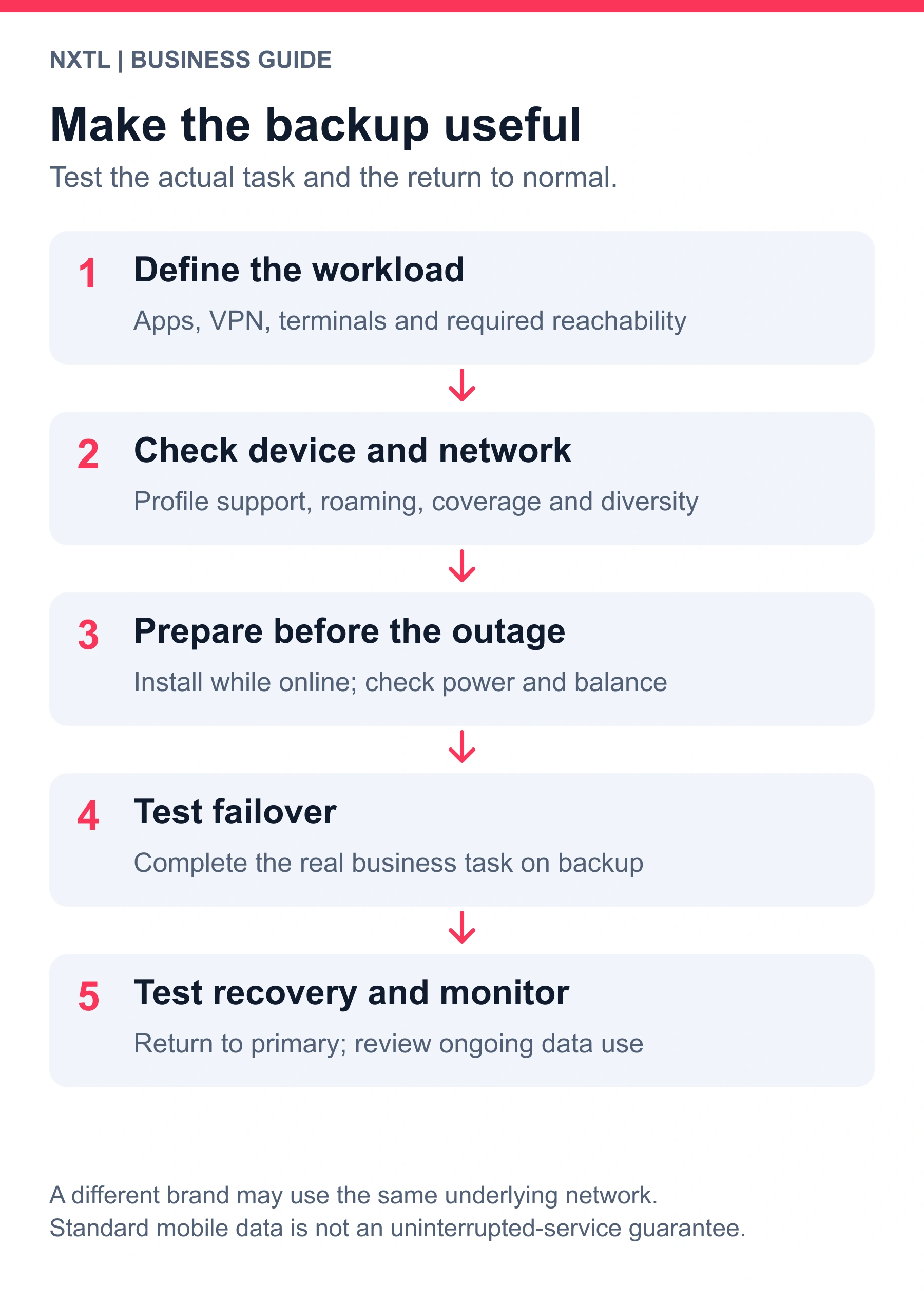
Backup readiness is an operational test, not a promise of uninterrupted service.
Check whether the backup is actually independent
Two retail brands can use the same underlying network. If both connections depend on the same tower, local power or upstream path, a failure can affect both. Check the actual supported operator and the network policy when diversity matters. NXTL's coverage information and network preference guide are useful starting points.
Also consider power for the phone or router, remaining balance, the internet connection needed for first installation and the ability to access instructions during an outage. Some networks or routers do not provide the inbound reachability a particular remote-access design expects. If your system needs static public IP, private APN, specific latency or an SLA, obtain explicit confirmation rather than assuming those features come with standard roaming data.
Keep maritime and in-flight data separate in the budget
An employee's normal supported-country data rate is not automatically the rate on an onboard aircraft or ship network. NXTL lists participating AeroMobile AS aircraft and Telenor Maritime AS passenger-vessel networks, subject to actual availability and published tariffs. Review these separately before enabling a sponsored onboard use case.
For most travel programmes, arrival, layover, port and shore use are useful first opportunities. “Works for cruise travel” should not become a promise of ocean-wide connectivity. The business use-case guide separates these scenarios.
Run a pilot that finance and IT can both evaluate
Record the route, devices, number of newly issued and reused profiles, actual data by applicable rate, support incidents, administration time and remaining balance. Use a comparable prior trip or a clearly priced alternative. Separate assumptions from measurements and report both cost and operational outcomes.
For backup, simulate loss of the primary connection, complete the intended business task and then restore the primary connection. Observe recovery and whether background data continues using the backup afterwards. Repeat this for the devices and applications that matter; do not generalise one office test to every branch or destination.
Agree the criterion for expanding the pilot. A rollout might be justified by lower relevant cost, simpler purchasing, faster assistance or a useful customer benefit. State which outcome you measured rather than turning every advantage into an unsupported saving percentage.
Questions finance and operations teams ask
Is PAYG always cheaper than bundles?
No. Compare the actual route, consumption, fees and an alternative that can supply the required data. PAYG can suit uneven or intermittent use, while some existing allowances or bundles may be more economical for a particular trip.
Is unused balance the same as wasted data?
No. NXTL's standard unused prepaid balance remains available under the account terms. It is still money already funded; do not count it both as an expense and as a cash saving in the same calculation.
Can we set our own limits without a provider FUP?
Yes. Business thresholds and suspension actions are company-selected controls. Usage reporting delays mean you should not promise an exact instantaneous spending ceiling from those rules alone.
Can an eSIM replace our business internet connection?
It may support a defined backup or temporary workload on compatible equipment in supported coverage. Validate the device, applications, cost, network diversity and any required service guarantees before depending on it.
How do we start?
Apply for NXTL Business with the route, device types, expected usage and the cost or backup problem you want to solve. If the pilot needs automation, use the app/API integration guide to plan the surrounding workflow.