eSIM is not only useful in smartphones. Depending on the hardware, mobile data can also power travel routers, portable hotspots, campervans, tablets, backup internet systems and some vehicle connectivity setups. In other cases, a device may have only a physical SIM slot, where a programmable physical eSIM adapter can sometimes bridge the gap.
The important part is compatibility. A normal consumer eSIM cannot simply be loaded into every car, modem or connected device. Factory-installed vehicle connectivity is often controlled by the manufacturer, while routers and hotspots vary in their eSIM support, modem bands, APN handling and SIM restrictions.
This guide explains where eSIM data can make sense beyond a phone, what to check before relying on it, and why pay-as-you-go connectivity is particularly interesting for devices that are used only occasionally.
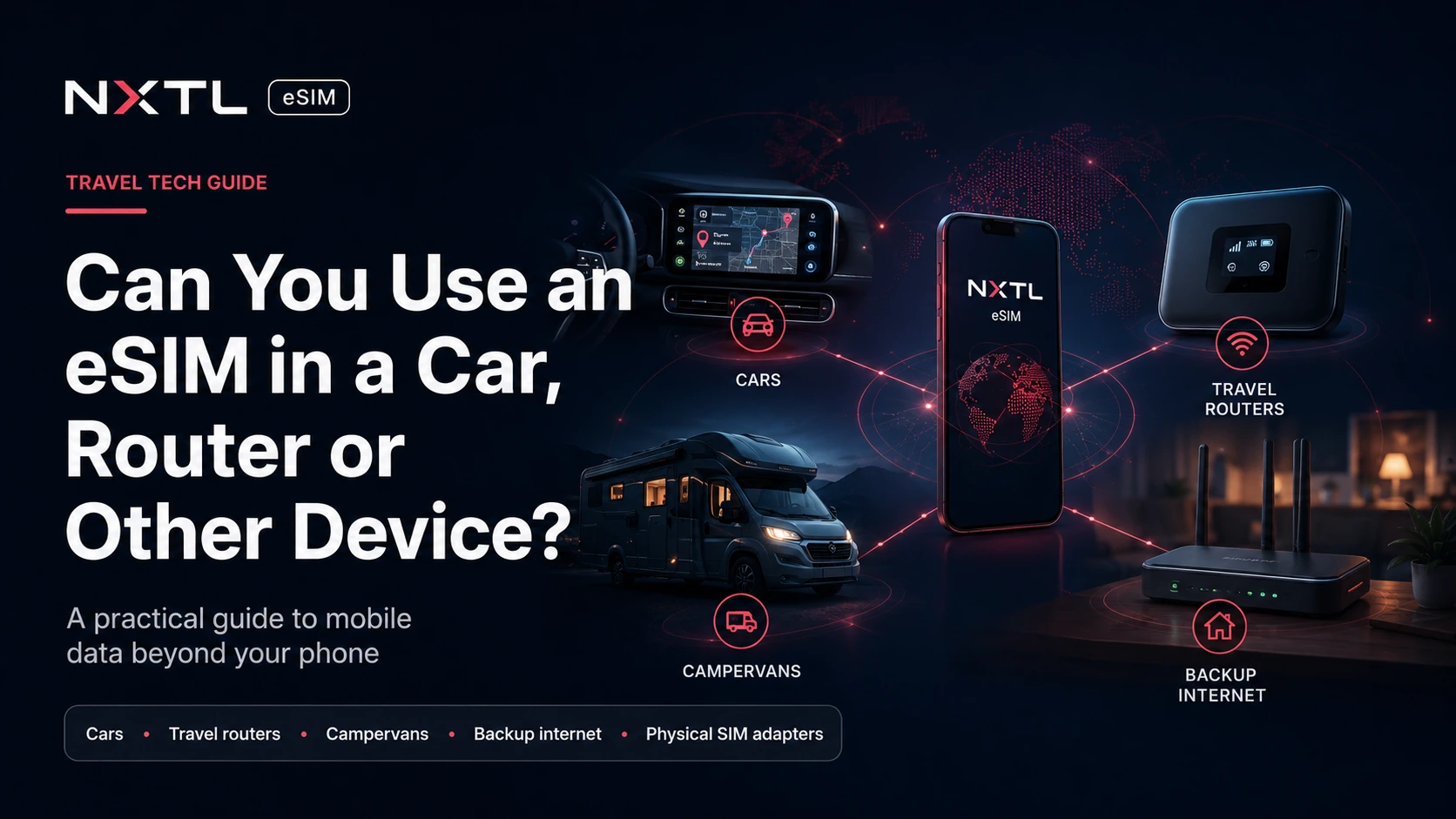
Can an eSIM work in a router or hotspot?
Yes — some modern cellular routers support eSIM directly. Others provide dual physical SIM slots, while some combine both physical SIM and eSIM support.
For example, current routers such as the Peplink B One 5G advertise eSIM plus dual physical SIM slots and support bring-your-own consumer eSIM profiles. Teltonika’s RUTM30 is another current 5G router with dual SIM and eSIM functionality. These products show that eSIM has moved well beyond phones and into dedicated networking hardware.
A travel router can be particularly useful when you want one mobile-data connection for several devices:
- laptops and tablets on a work trip;
- a family travelling with several phones;
- a campervan or motorhome;
- a hotel room where Wi-Fi is unreliable;
- a temporary office or event;
- backup internet when fixed broadband fails.
Before buying a router specifically for travel eSIM use, check whether it is carrier-unlocked, which cellular bands it supports, whether it accepts consumer eSIM profiles, whether APN settings can be changed and whether hotspot or router use is permitted on the mobile service you plan to use.
Why pay-as-you-go can be useful for backup devices
A recurring mobile-data bundle makes sense when a device uses a predictable amount of data every month. It can be less attractive when the device spends most of its life waiting for an emergency.
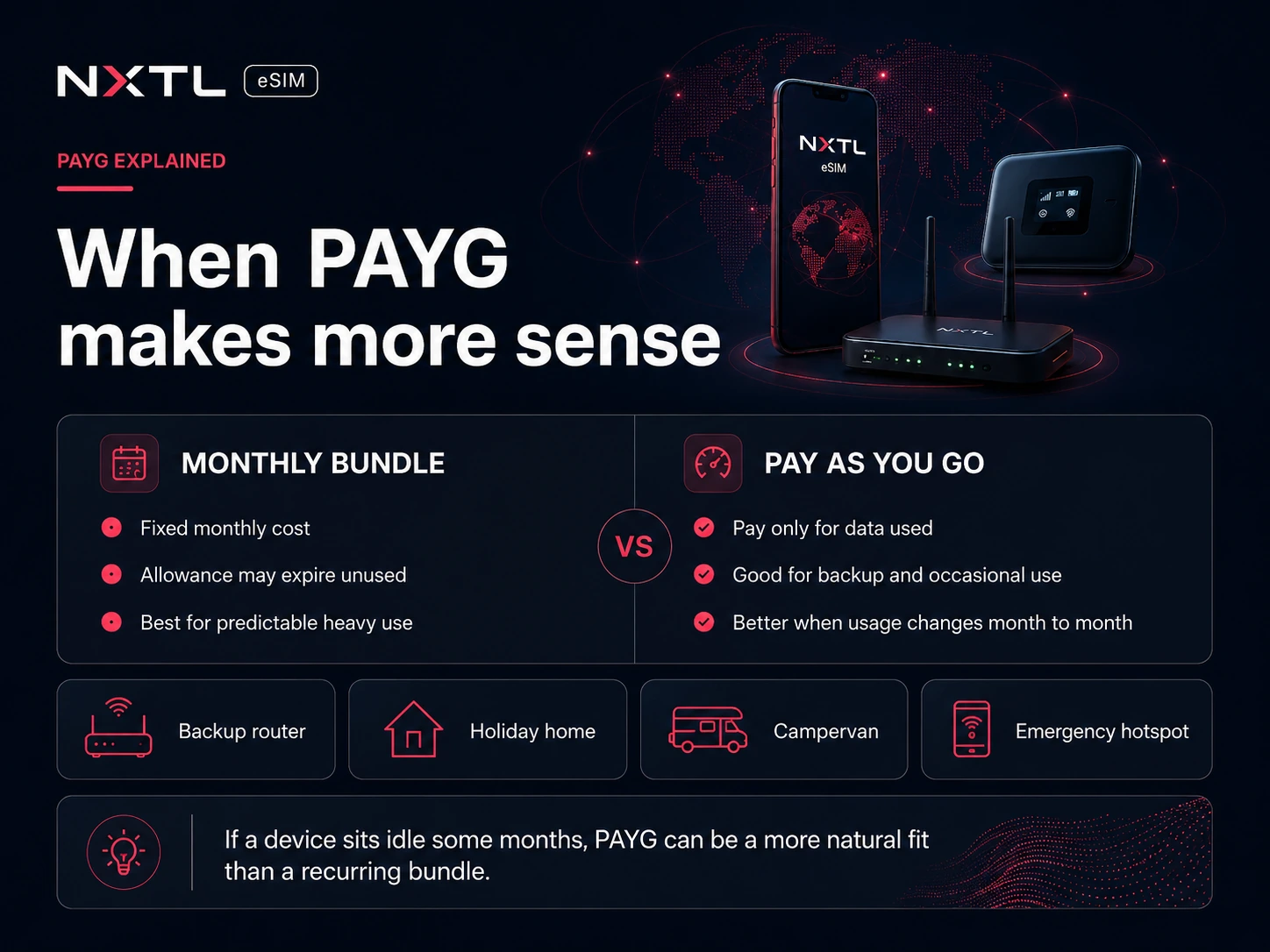
Consider a 4G or 5G router kept purely as a backup for home broadband. It might consume no mobile data for several months, then suddenly become important when fibre or cable service fails. The same logic applies to a holiday property, emergency hotspot or campervan that may sit unused between trips.
With NXTL, mobile data is deducted from a prepaid balance according to the live per-GB rate for the destination and network. There is no standard monthly bundle to renew, and the standard account balance does not expire. That makes the model naturally suited to situations where a connection should be ready even though it is not being used continuously.
Always compare the live PAYG rate with a large fixed bundle if the device will consume heavy amounts of data. A high-volume home router streaming video every day may be better suited to a dedicated broadband or unlimited mobile plan. PAYG is most compelling where usage is intermittent or difficult to predict.
Can you use an eSIM in a car?
Sometimes — but cars are more complicated than phones or routers.
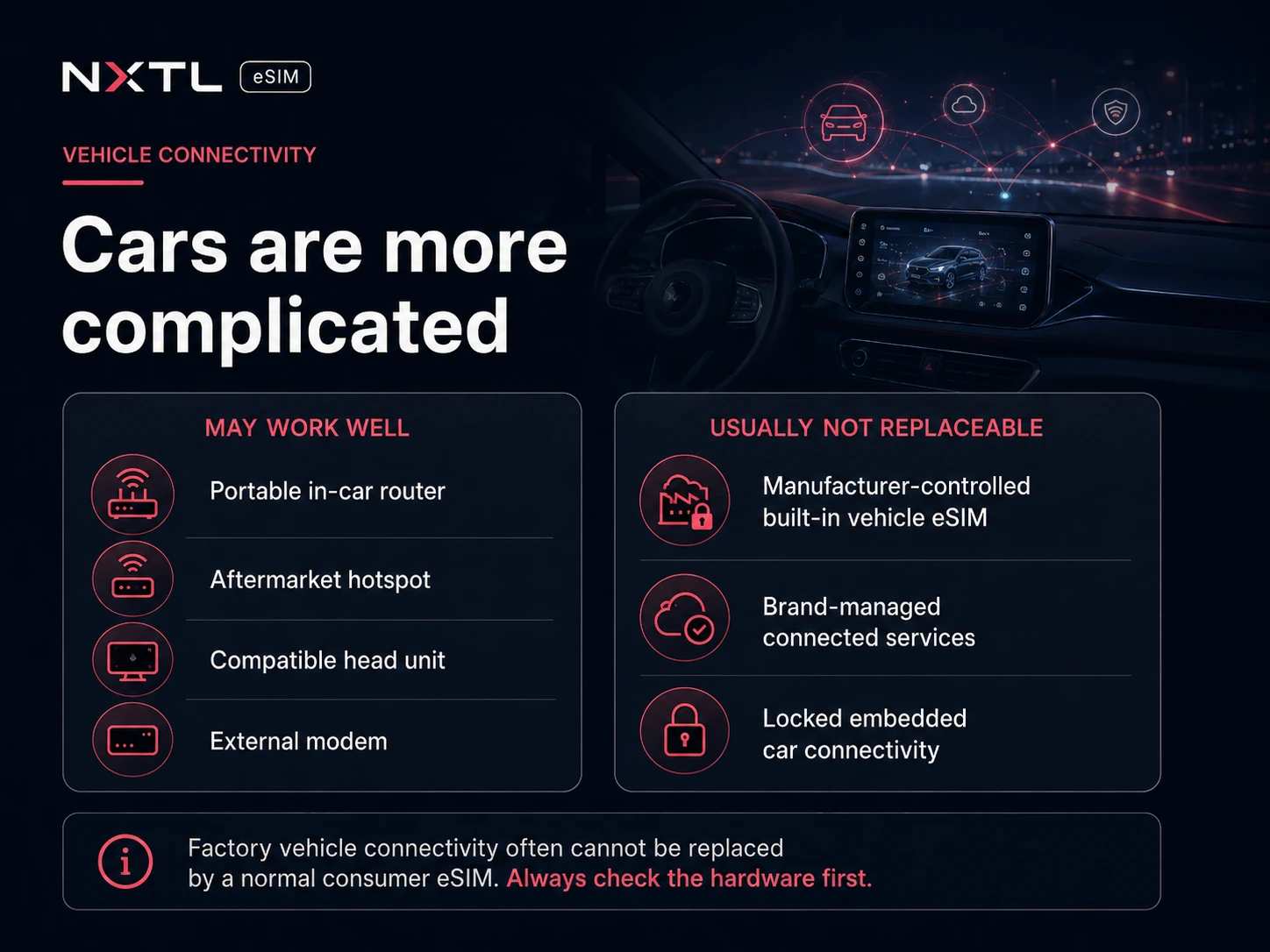
Many modern vehicles contain an embedded SIM or eSIM for connected services. That does not mean the owner can replace the manufacturer’s profile with an ordinary travel eSIM. Built-in connectivity may be locked to the manufacturer, telematics provider or contracted carrier and may be tied to emergency calling, diagnostics, remote-control functions or subscription services.
More practical consumer options include:
- portable in-car routers — a small 4G/5G router provides Wi-Fi to passengers and devices;
- aftermarket hotspots — dedicated mobile hotspots powered from the vehicle;
- compatible aftermarket head units — some Android-based units accept SIM connectivity;
- external cellular modems — useful for navigation, entertainment or work setups;
- campervan routers — often a better approach than relying on the vehicle’s factory modem.
So the right question is not simply “does my car have eSIM?” It is:
“Does the specific modem or connectivity device give me control over the mobile profile?”
If the answer is no, a consumer eSIM cannot normally replace the factory service. If the car is using a separate unlocked router or hotspot, the setup becomes much more similar to any other cellular data device.
Why a car or campervan is an interesting PAYG use case
A car may need data for navigation, traffic information, music, passengers’ Wi-Fi, remote work or connected accessories — but many vehicles do not use large amounts every day.
A campervan makes the idea even more interesting. It may:
- cross several countries during one trip;
- remain parked for weeks between journeys;
- need internet for multiple passenger devices;
- alternate between campsite Wi-Fi and cellular data;
- need a mobile backup when local Wi-Fi fails.
A reusable global data profile is attractive in that situation because there is less need to treat each border or trip as a new connectivity purchase. With NXTL, the same eSIM and account balance can continue across supported destinations, with usage charged according to the applicable live rate.
What about holiday homes and backup internet?
This is one of the clearest non-phone use cases.
Imagine a property that is used for only a few weeks each year. Paying for a full mobile subscription every month may not be necessary if cellular data is only needed during visits or as a fallback connection.
A compatible 4G/5G router can instead remain available for:
- temporary internet during visits;
- backup when the primary ISP fails;
- remote-work emergencies;
- short-term guests;
- temporary network installation while waiting for fixed broadband.
For always-on CCTV, IoT or security equipment, examine the data requirement carefully. Continuous camera uploads can consume substantial amounts of data, while some remote-access setups also depend on public-IP, CGNAT, VPN or inbound-connectivity requirements. A general-purpose travel eSIM should not automatically be treated as a replacement for a specialised IoT or M2M service.
Can tablets, laptops and other devices use eSIM?
Yes, where the hardware includes native eSIM support. Many tablets and some laptops now include cellular modems with eSIM capability. Other devices may connect through a USB modem, portable router or hotspot instead.
For a traveller, the practical options are usually:
- native eSIM directly in the device;
- share data from a phone hotspot;
- use a dedicated travel router;
- use a physical eSIM adapter where the device has a compatible SIM slot.
A dedicated router becomes more attractive when several devices need to stay connected at once, when the phone should not be used as a permanent hotspot, or when the connection needs to remain available while the phone leaves the room or vehicle.
What if the device only has a physical SIM slot?
An emerging option is a programmable physical eSIM adapter: a SIM-card-shaped eUICC that stores eSIM profiles and is inserted into a standard SIM tray.
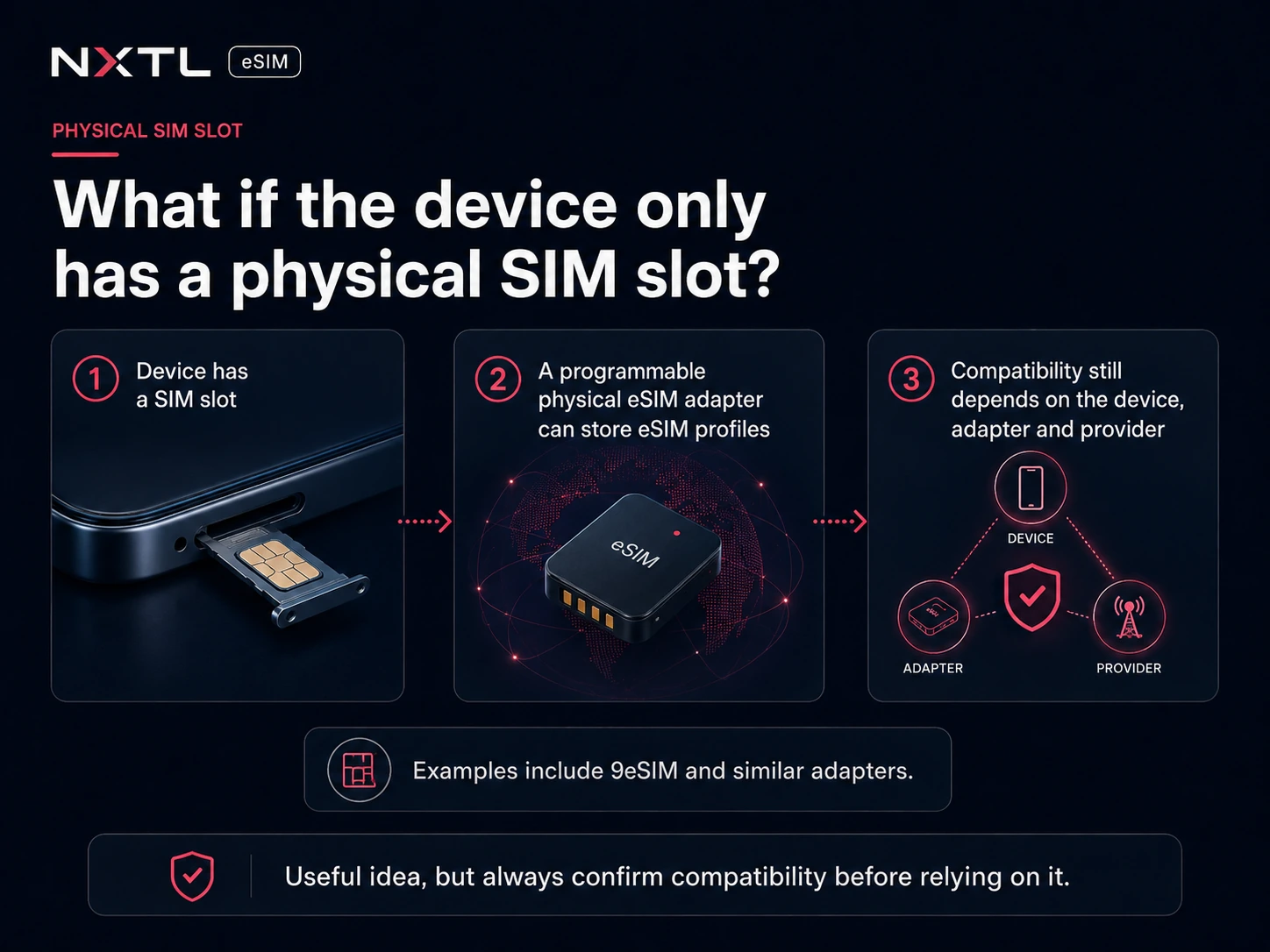
9eSIM is one current example. Its V3 is a reusable physical card with 1.5 MB of storage and is advertised to hold up to 50 eSIM profiles. The company also offers applications and a card reader for loading profiles.
This does not mean every eSIM provider, adapter and device combination will work. Compatibility can depend on:
- the device and its SIM implementation;
- the physical adapter;
- the eSIM profile;
- the modem’s supported bands;
- APN configuration;
- carrier or provider restrictions.
NXTL has not independently tested or certified compatibility with 9eSIM. Anyone considering this type of setup should confirm device, adapter and profile compatibility before relying on it as their only connection.
Native eSIM router or physical adapter: which is better?
If you are buying new networking hardware specifically for eSIM use, native eSIM support is generally the cleaner option. It removes the extra adapter layer and is designed around profile management from the start.
A physical eSIM adapter becomes more interesting when:
- you already own otherwise suitable hardware;
- the device has a physical SIM slot but no native eSIM;
- you want the ability to move a loaded physical card between compatible devices;
- replacing the router or modem would cost substantially more than adding an adapter.
Before using an eSIM outside a phone: compatibility checklist
- Is the device carrier-unlocked?
- Does it support the cellular bands used where you will travel?
- Does it support native consumer eSIM, or does it require a physical SIM?
- If using an adapter, is that adapter compatible with the device?
- Can you configure the APN?
- Can data roaming be enabled if required?
- Does the mobile provider permit hotspot/router use?
- Are you relying on inbound connections, static IP or special VPN behaviour?
- Have you tested the setup before depending on it?
Why this use case fits NXTL
NXTL’s consumer service is a reusable global, data-only eSIM built around pay-as-you-go usage rather than expiring country bundles. That design is useful not only for holidays but also for compatible devices that may need data irregularly.
- One reusable eSIM: keep the profile rather than buying a fresh bundle for every trip.
- Pay only for data used: useful when a backup device may sit idle.
- No standard balance expiry: remaining prepaid value stays available for later.
- Multi-country use: the same balance continues in supported destinations at each destination’s live rate.
- Network choice: several networks may be available in a destination, with live pricing shown by network.
NXTL currently provides consumer data coverage across more than 180 countries and hundreds of networks. Because live coverage and per-GB rates change, check the current tables before relying on a particular destination, network or device setup.
Check live NXTL data rates →
Check current eSIM coverage and networks →
Final answer
Yes, eSIM data can be useful in far more than a smartphone. Native eSIM routers already exist, portable hotspots can provide Wi-Fi to whole groups of devices, campervans can carry their own cellular connection, and physical eSIM adapters may extend eSIM profiles to some hardware with conventional SIM slots.
Cars require more care: an aftermarket router or modem may be straightforward, while a manufacturer-controlled built-in vehicle eSIM usually cannot simply be replaced with a consumer travel profile.
The broader lesson is that mobile data does not have to be purchased only for a single phone or a single holiday. For compatible devices that travel, sit on standby or are used occasionally, reusable pay-as-you-go connectivity can be a much more flexible model.
Compatibility varies by device, modem, destination and provider. Always test critical connectivity before relying on it.