The Czech Republic is one of Central Europe’s most rewarding cultural landscapes: a compact nation of Gothic spires, forested river gorges, Renaissance towns, and a brewing tradition that spans over a millennium. For millions of international visitors, however, Czech travel begins and ends inside the crowded historic core of Prague. Those who do venture beyond the capital frequently make a punishing planning mistake: attempting a six-hour round-trip excursion to Český Krumlov on an overcrowded highway bus. Spending five to six hours in transit leaves travellers with barely three midday hours in the town, exactly when day-tripping tour groups pack the narrow medieval lanes, before rushing back to Prague exhausted.
A sensible first journey treats Bohemia as a cohesive geographic arc connected by the country’s outstanding national railway network. This seven-day itinerary establishes a balanced progression: three nights in Prague exploring Gothic landmarks, historic riverside quarters, and neighborhood culinary districts, followed by a direct rail journey south into the rolling landscape of South Bohemia for three nights based in České Budějovice and Český Krumlov. By staying overnight in the south, you experience Český Krumlov in the tranquil morning and evening hours after tour coaches depart, while unlocking surrounding Renaissance châteaux, freshwater fishpond reserves, and regional brewing culture. Here is your practical operational guide to train ticketing, local transport apps, currency realities, and regional routing.
Trip Planning Blueprint: Rail Connections, Bases, and Seasonal Timing
The operational backbone of this route is the Czech national rail carrier, České dráhy (ČD). Direct express trains (known as the *Jižní expres*) depart hourly from Prague’s Main Railway Station (Praha hlavní nádraží) to České Budějovice, covering the distance in one hour and forty minutes aboard modern, air-conditioned carriages equipped with power sockets and complimentary Wi-Fi. From České Budějovice, regional connecting trains reach Český Krumlov in forty-five minutes, winding gently through pine woodlands along the upper Vltava River. Travelling by train eliminates the stress of driving through narrow historical zones where vehicle permits are restricted and parking is severely limited.
Selecting your overnight bases dictates your daily comfort. In Prague, avoid staying directly beside Old Town Square or Charles Bridge, where crowds and late-night noise persist until dawn. Instead, base yourself in neighboring districts like Vinohrady, Karlín, or Malá Strana, which offer quiet residential streets, excellent tram links, and authentic neighborhood pubs. In South Bohemia, divide your stay or base yourself directly in České Budějovice or Český Krumlov. České Budějovice offers lower hotel rates, authentic local life, and acts as the central railway hub, while an overnight in Český Krumlov rewards you with atmospheric lantern-lit cobblestone streets once day visitors vanish.
Seasonality in Bohemia shapes both crowds and regional activities. May through June and September through October represent the optimal travel windows: daytime temperatures range between eighteen and twenty-four degrees Celsius, autumn foliage colors the Vltava valley, and the summer rush subsides. High summer (July and August) brings warm weather ideal for rafting the Vltava River, but popular monuments become congested. Winter (December through February) brings romantic holiday markets to Prague and České Budějovice, though some regional castles outside Prague close or operate on restricted weekend-only schedules.
| Day / Stage | Base | Highlights | Transport Mode | Transit Time | Advance Booking Requirement |
|---|---|---|---|---|---|
| Day 1 | Prague (Old Town / Vinohrady) | Arrival at Václav Havel Airport, Old Town Square, Astronomical Clock, Charles Bridge twilight walk | Airport Express Bus & Metro | 35 mins airport transit | Prague integrated transport ticket |
| Day 2 | Prague (Hradčany / Malá Strana) | Prague Castle complex, St. Vitus Cathedral, Golden Lane, Wallenstein Garden, historic tram ride | Prague Tram Network | Urban transit base | Prague Castle circuit ticket (Circuit A) |
| Day 3 | Prague (Vyšehrad / Karlín) | Vyšehrad fortress ramparts, Slavín cemetery, riverside walk along Náplavka, Karlín food scene | Metro Line B / C & Walking | Urban transit base | Evening traditional pub reservation |
| Day 4 | České Budějovice | Express train south, Přemysl Otakar II Square, Black Tower climb, original Budweiser Budvar brewery | ČD Jižní Expres Train | 1 hr 40 mins direct rail | ČD train seat reservation |
| Day 5 | Český Krumlov | Morning train to Krumlov, Castle tower and courtyards, Baroque theater, Vltava riverbend walk | ČD Regional Train | 45 mins scenic rail | Baroque Theater guided tour ticket |
| Day 6 | Český Krumlov / Třeboň | Day trip to neo-Gothic Hluboká Castle or the historic carp-pond biosphere reserve in Třeboň | Regional Bus / Local Train | 30–45 mins each way | Hluboká Castle interior tour slot |
| Day 7 | Prague departure | Morning café breakfast, direct express train return to Prague, transit to Václav Havel Airport | ČD Express Train & Bus | 1 hr 40 mins rail + 35 mins bus | Outbound flight check-in |
Days 1–3: Prague’s Architectural Layers Beyond the Tourist Crowds
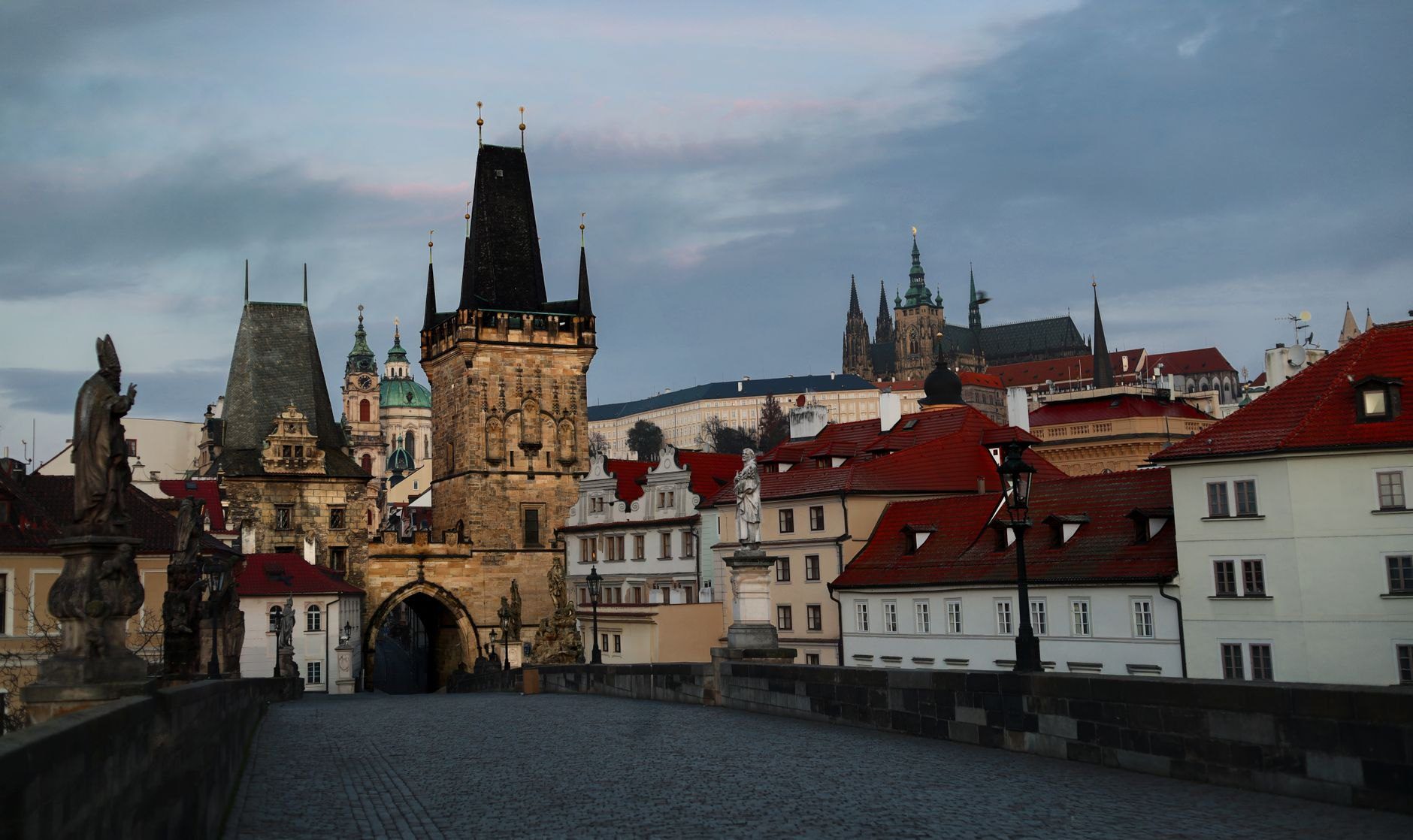
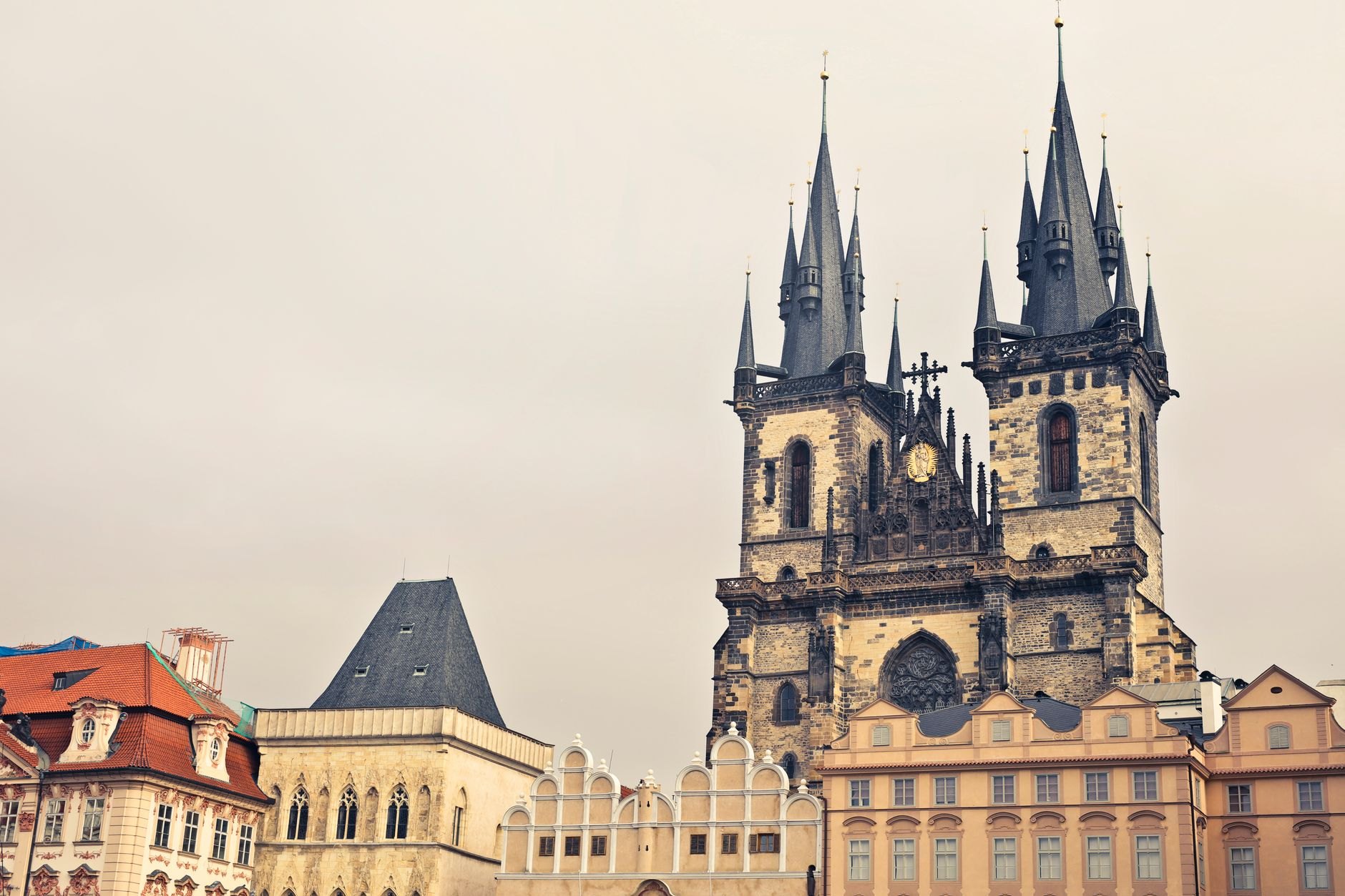
Your journey begins at Prague Václav Havel Airport (PRG). Rather than falling prey to aggressive private taxi touts in the arrivals terminal, take the dedicated Airport Express (AE) bus directly to Praha hlavní nádraží (Main Railway Station), or catch municipal bus 119 to Nádraží Veleslavín metro station to access the city center within thirty-five minutes. Establish your base, purchase a 72-hour Prague Integrated Transport (PID) pass for 330 CZK, and begin exploring Old Town (Staré Město). While Old Town Square and the 15th-century Astronomical Clock are unmissable, visit them early in the morning before ten or after eight in the evening to appreciate their Gothic beauty without dense tour groups.
On your second morning, cross the Vltava River early to explore Prague Castle (Pražský hrad), the largest ancient castle complex in the world. Ascend through the quiet cobblestone lanes of Malá Strana before tour groups arrive. Enter Saint Vitus Cathedral to admire its towering Gothic nave, Renaissance tomb monuments, and brilliant stained-glass windows designed by Art Nouveau master Alfons Mucha. Afterward, wander the peaceful manicured hedges and baroque fountains of the Wallenstein Garden, where white peacocks roam freely beneath the Senate palace.
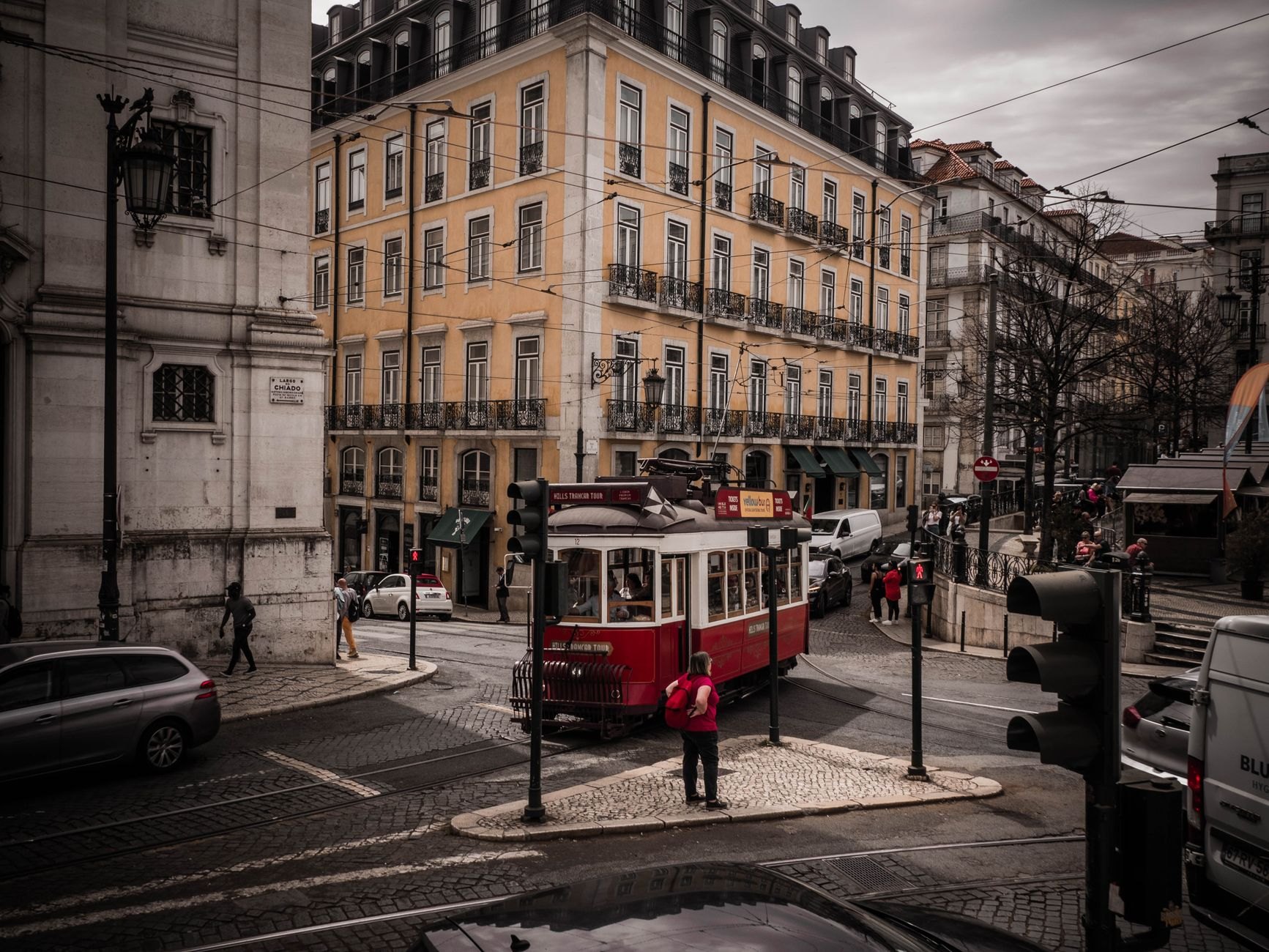
Spend your third day escaping standard tourist circuits by riding tram 17 south along the riverbank to Vyšehrad. Perched atop a rocky promontory overlooking the Vltava, this 10th-century fortress offers panoramic views across the city without crowds. Walk the neo-Gothic Basilica of Saints Peter and Paul and the neighboring Slavín Cemetery, the final resting place of Czech cultural legends including composers Antonín Dvořák and Bedřich Smetana. In the evening, head to the Karlín neighborhood, where industrial 19th-century brick warehouses have been converted into modern bakeries, microbreweries, and contemporary bistros.
Day 4: Southward by Rail: České Budějovice and Royal Brewing Heritage
On morning four, check out of your Prague accommodation and board the comfortable ČD Jižní expres at Praha hlavní nádraží. Within twenty minutes, urban apartment blocks give way to rolling Bohemian fields, dense spruce forests, and peaceful country river valleys. The train glides south into České Budějovice, the administrative and cultural heart of South Bohemia, founded in 1265 by King Přemysl Otakar II.
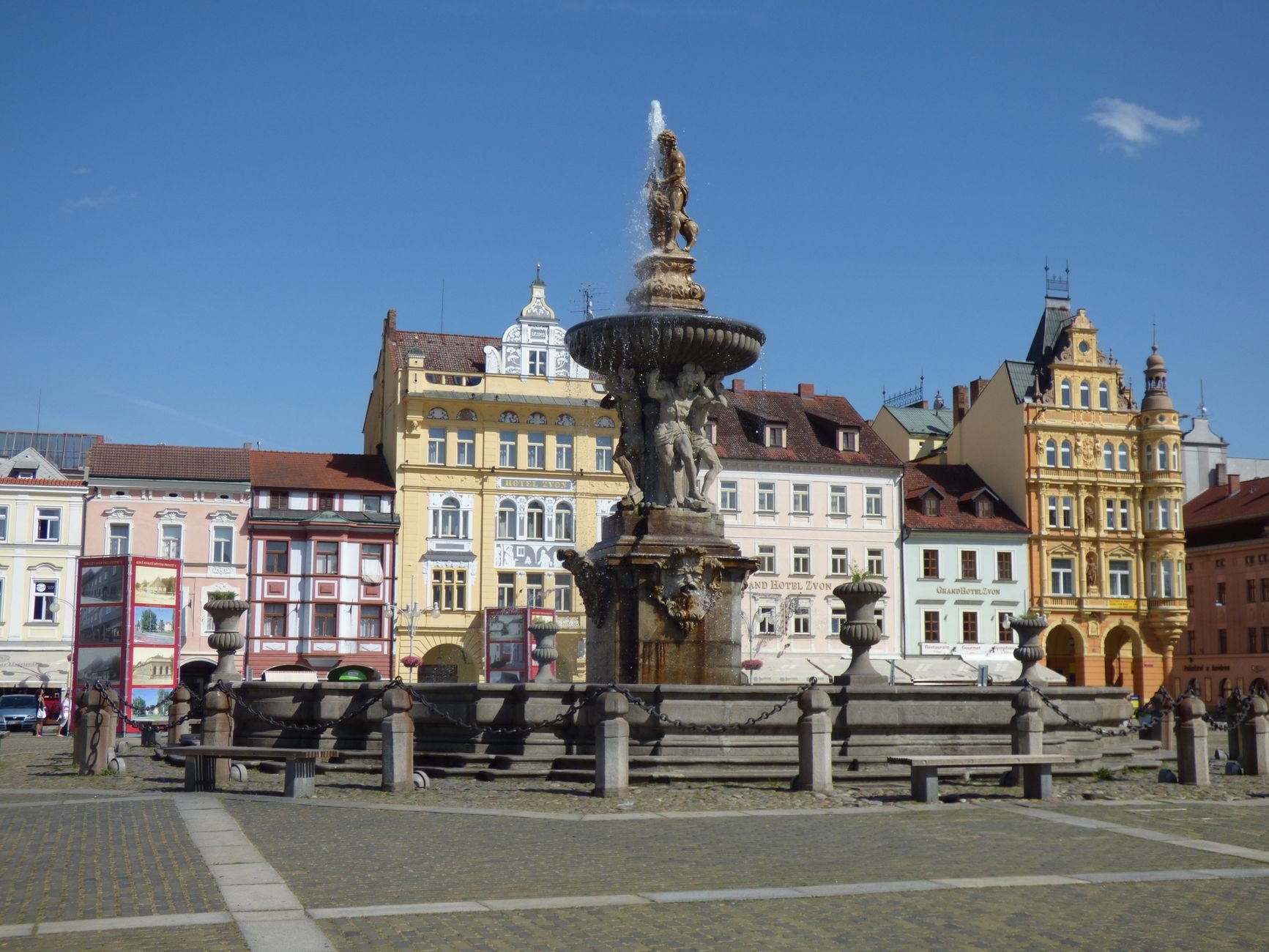
The city’s centerpiece is Přemysl Otakar II Square, one of the largest arcaded Renaissance squares in Central Europe, measuring an exact square of 133 meters on each side. Lined with pastel-painted baroque and Renaissance burgher houses, the square is anchored by the monumental 18th-century Samson’s Fountain. Climb the 225 steps of the adjacent Black Tower (Černá věž) for sweeping views across the terracotta rooftops toward the Bohemian Forest. In the afternoon, take a short bus ride to the Budweiser Budvar Brewery for an informative tour through the cold subterranean lagering cellars, where unpasteurized lager is tapped directly from conditioning tanks.
Spend your evening dining at Masné krámy (“Meat Benches”), a historic 16th-century market hall converted into an authentic traditional beer hall, enjoying freshly pulled tank beer alongside roasted pork knuckle and potato dumplings.
Days 5–6: Český Krumlov: The Medieval Vltava River Loop and Regional Detours
On morning five, board the local passenger train from České Budějovice to Český Krumlov. As the train nears the town, the Vltava River loops dramatically through a deep rocky ravine. Český Krumlov is an architectural marvel: a dense cluster of over three hundred Gothic and Renaissance heritage buildings curled inside a triple loop of the river, crowned by the massive pink cylindrical tower of Český Krumlov Castle.
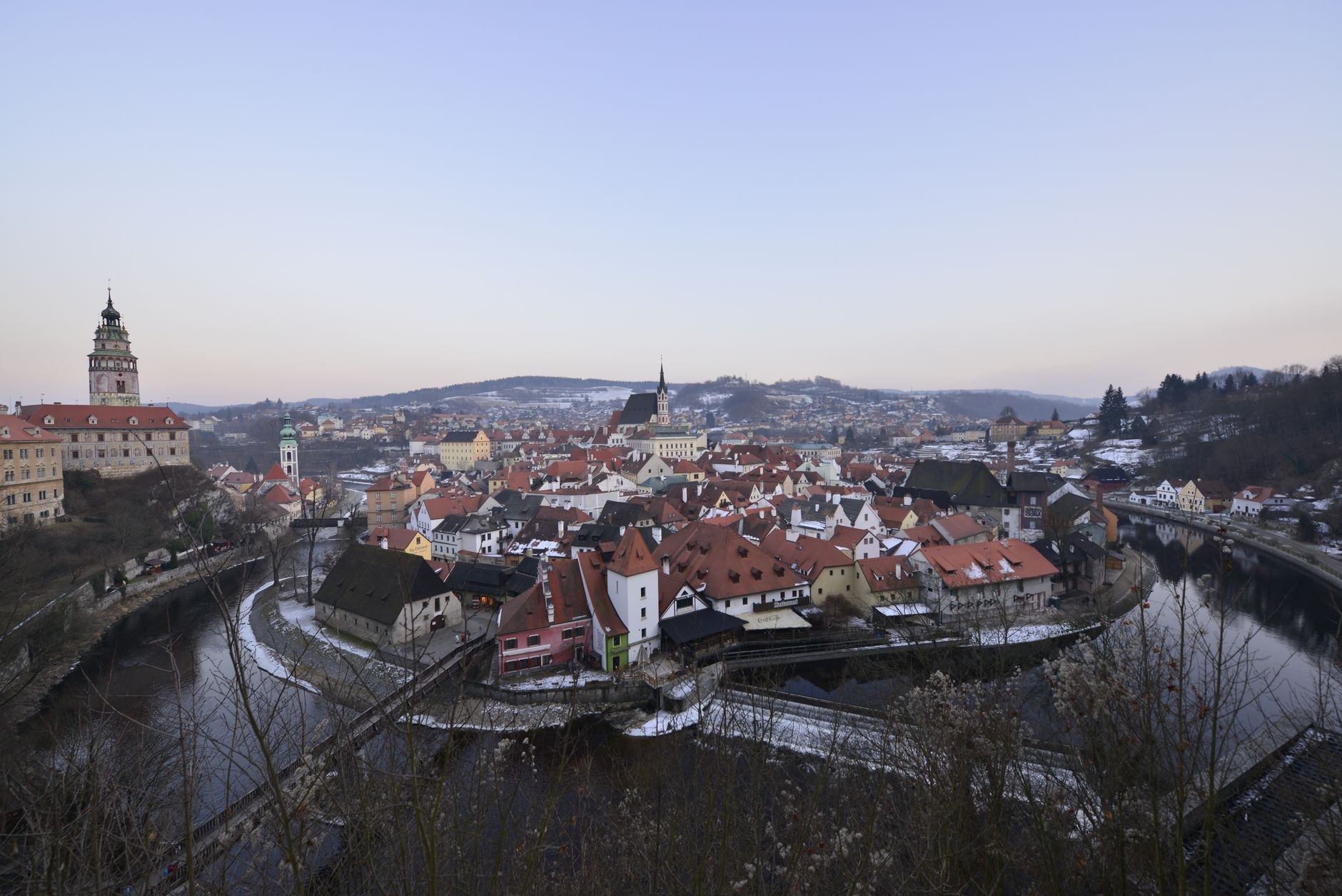
Begin your exploration at the Castle complex, Central Europe’s second-largest historical fortress after Prague Castle. Tour the five monumental courtyards, cross the towering multi-tiered Cloak Bridge spanning a deep moat, and secure tickets well in advance for the world’s best-preserved Baroque Castle Theater, complete with original 18th-century stage machinery, painted backdrops, and mechanical sound effects. By four in the afternoon, day-tour coaches depart, leaving the quiet stone lanes to overnight guests. Stroll along the riverbanks, watching wooden rafts glide past water weirs, and dine at a riverside tavern overlooking the illuminated castle rock.
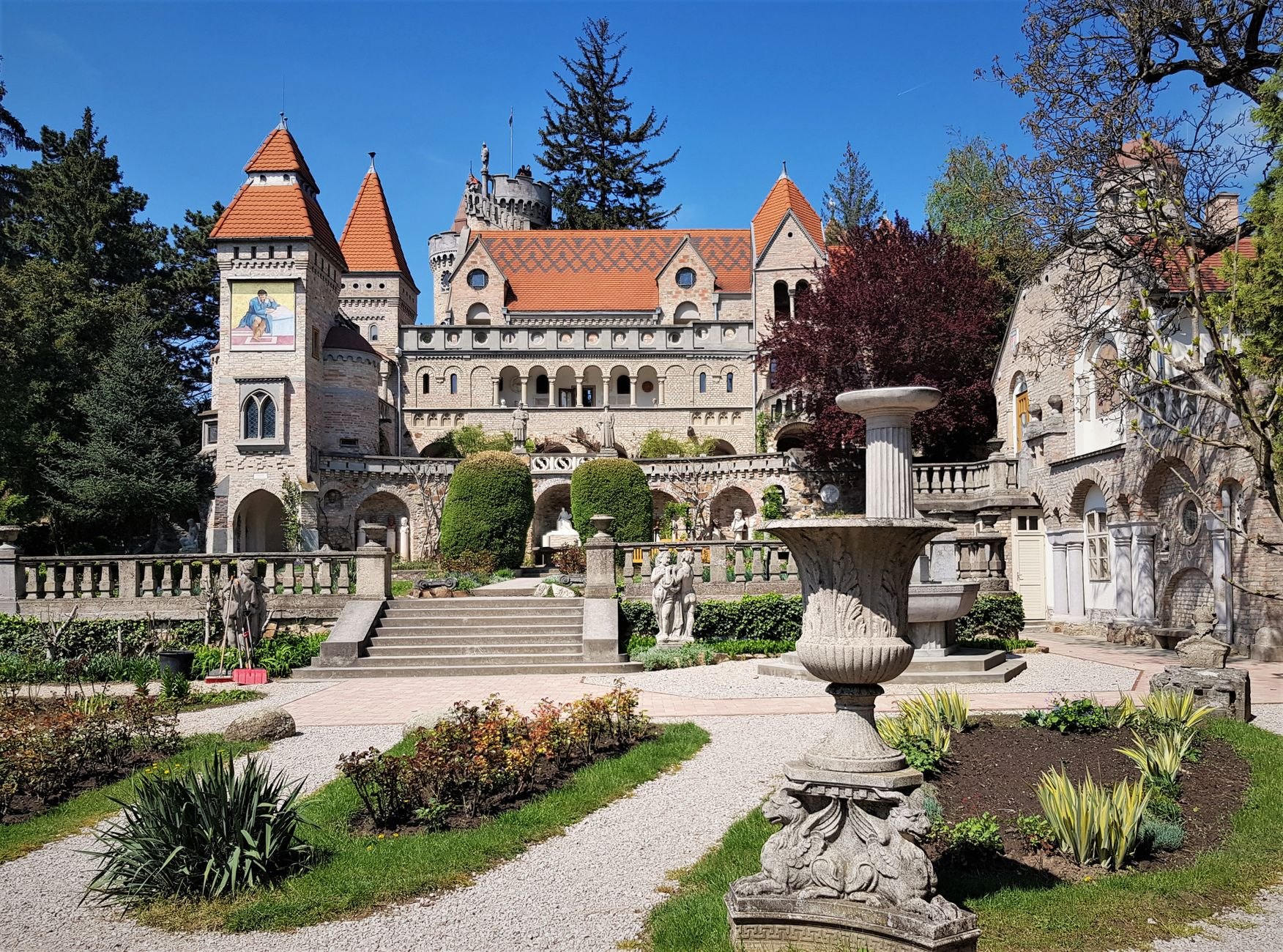
On day six, choose between two outstanding regional excursions. Twelve kilometers north of České Budějovice lies Hluboká Castle, a romantic white palace rebuilt in the 19th century in the English Tudor Gothic style, inspired by Windsor Castle. Its lavishly wood-carved state rooms, private armory, and landscaped royal parklands make it one of Central Europe’s most photogenic residences.
Alternatively, take a thirty-minute regional train east to Třeboň, the historic center of Czech freshwater aquaculture. In the 16th century, visionary Renaissance landscape engineers constructed an ingenious network of over four hundred fishponds interconnected by artificial canals. Today, the Třeboňsko Biosphere Reserve is a protected natural haven crisscrossed by level cycling trails, peat bogs, and serene oak-lined dykes, where local taverns serve fresh roasted South Bohemian carp prepared according to centuries-old recipes.
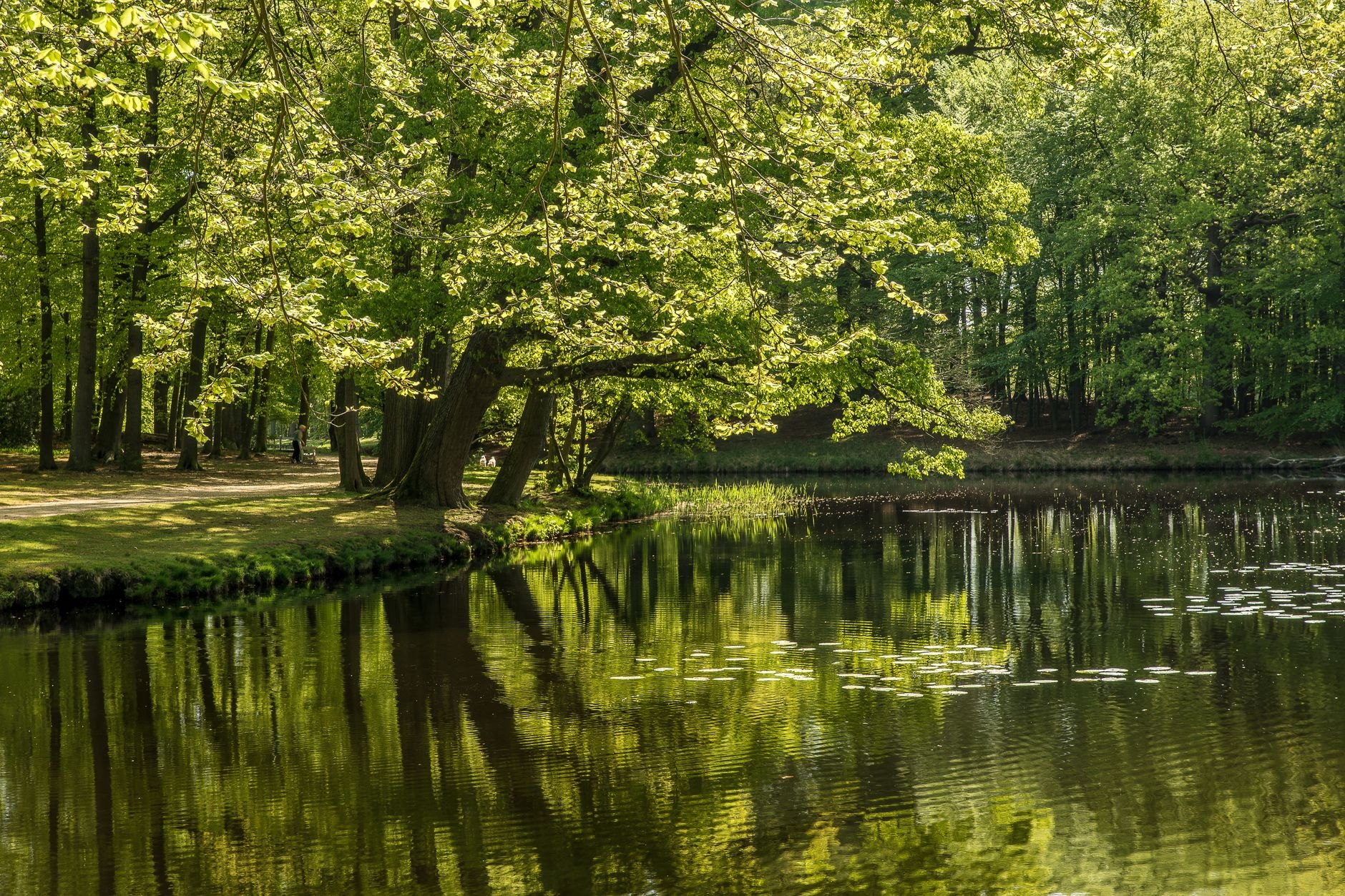
Conclude your South Bohemian stay with an evening stroll through Třeboň’s Renaissance square, sampling local herbal liqueur or fresh unpasteurized Regent beer brewed right on the town moat.
Czech Culinary Heritage: Bohemian Comfort and Beer Culture
Bohemian gastronomy is rich, hearty, and meticulously designed to accompany the world’s most refined lagers. The undisputed crown jewel of Czech comfort food is *svíčková na smetaně*: larded beef sirloin braised with root vegetables (carrots, celeriac, and parsley root), finished with heavy cream, and served alongside fluffy sliced bread dumplings (*houskové knedlíky*), a slice of lemon, a dollop of spiced cranberries, and whipped cream.
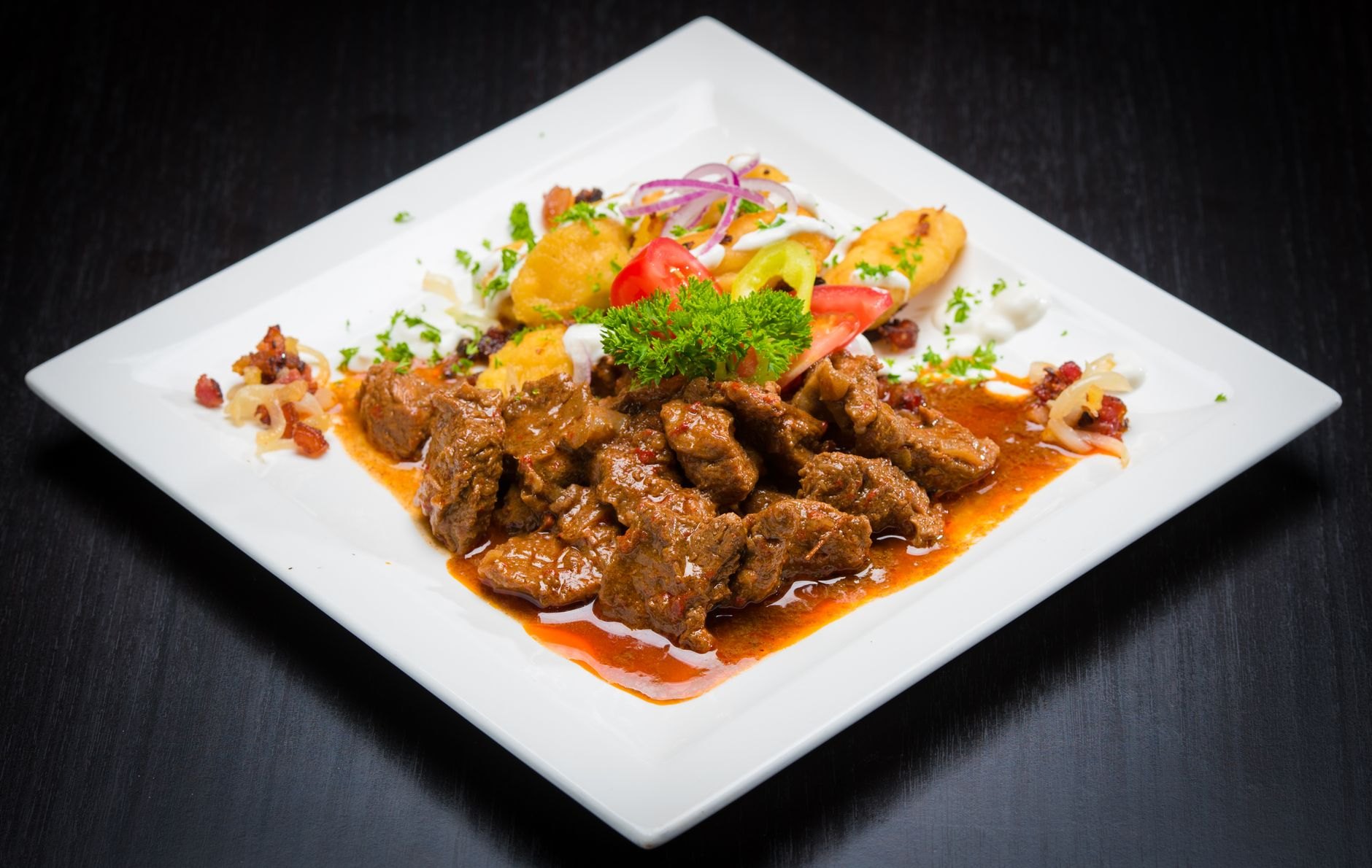
Other traditional staples include *vepřo knedlo zelo* (roast pork with dumplings and braised sauerkraut), crispy potato pancakes (*bramboráky*), and pickled Camembert-style cheese (*nakládaný hermelín*) infused with garlic and hot peppers in oil. In traditional beer halls, beer is treated with culinary reverence. Ordering a pilsner comes with choices of pour style: *hladinka* (standard pour with three fingers of dense foam), *šnyt* (a half-glass pour with generous foam), or *mlíko* (a glass filled almost entirely with sweet, creamy beer foam).
Route Adaptations: Express vs. Extended Itineraries
This seven-day route provides the optimal first-timer balance, but can be tailored to your schedule:
The 4-Day Express Route: If limited to four days, spend two nights in Prague and take an early morning express train to České Budějovice for a single overnight stay, visiting Český Krumlov as an afternoon excursion before returning to Prague on day four.
The 10-Day Extended Grand Bohemian Route: With ten days, expand your journey west from Prague into the West Bohemian Spa Triangle (Karlovy Vary, Mariánské Lázně, and Plzeň). Spend two nights touring the opulent Art Nouveau colonnades and mineral springs in Karlovy Vary, stop in Plzeň to visit the birthplace of Pilsner Urquell, and then continue south into Český Krumlov.
Essential Logistics: Train Booking, Apps, Currency, and Payments
Practical operational advice ensures smooth navigation across the Czech Republic:
Railway Ticketing and Digital Apps: Download the official “Můj Vlak” (My Train) app from České dráhy before your trip. The app allows you to purchase domestic and international train tickets, track live train departure platforms, view real-time delay notices, and select seat reservations without needing paper printouts. For Prague public transport, use the “PID Lítačka” app to buy transit tickets directly on your smartphone.
Currency and Card Payments: The legal currency is the Czech Koruna (CZK). Although the Czech Republic is an EU member state, it has not adopted the euro. Credit and debit cards (Visa and Mastercard) are accepted almost everywhere, from Prague trams and museums to small town restaurants. While some souvenir shops quote prices in euros, their exchange rates are predatory. Always choose to pay in local CZK when card terminals present a currency choice.
Public Transport Validation Rules: In Prague, paper public transport tickets must be stamped in yellow validation machines before boarding the metro or immediately upon entering trams and buses. A validated ticket allows unlimited transfers across metro lines, trams, and buses within its time limit (thirty minutes, ninety minutes, or twenty-four hours). Plainclothes ticket inspectors check tickets regularly and issue non-negotiable on-the-spot fines of 1,000 CZK for unvalidated tickets.
Mobile Connectivity and Digital Navigation in Bohemia
Dependable mobile connectivity is essential for tracking train departures on the Můj Vlak app, calling ride-hailing vehicles via Liftago or Uber in Prague, navigating walking routes through medieval alleyways, and checking opening hours for regional castles. The Czech Republic features one of Europe’s most reliable and technologically advanced mobile networks, with robust 5G and 4G coverage extending across urban centers, rural railway corridors, and South Bohemian waterways.
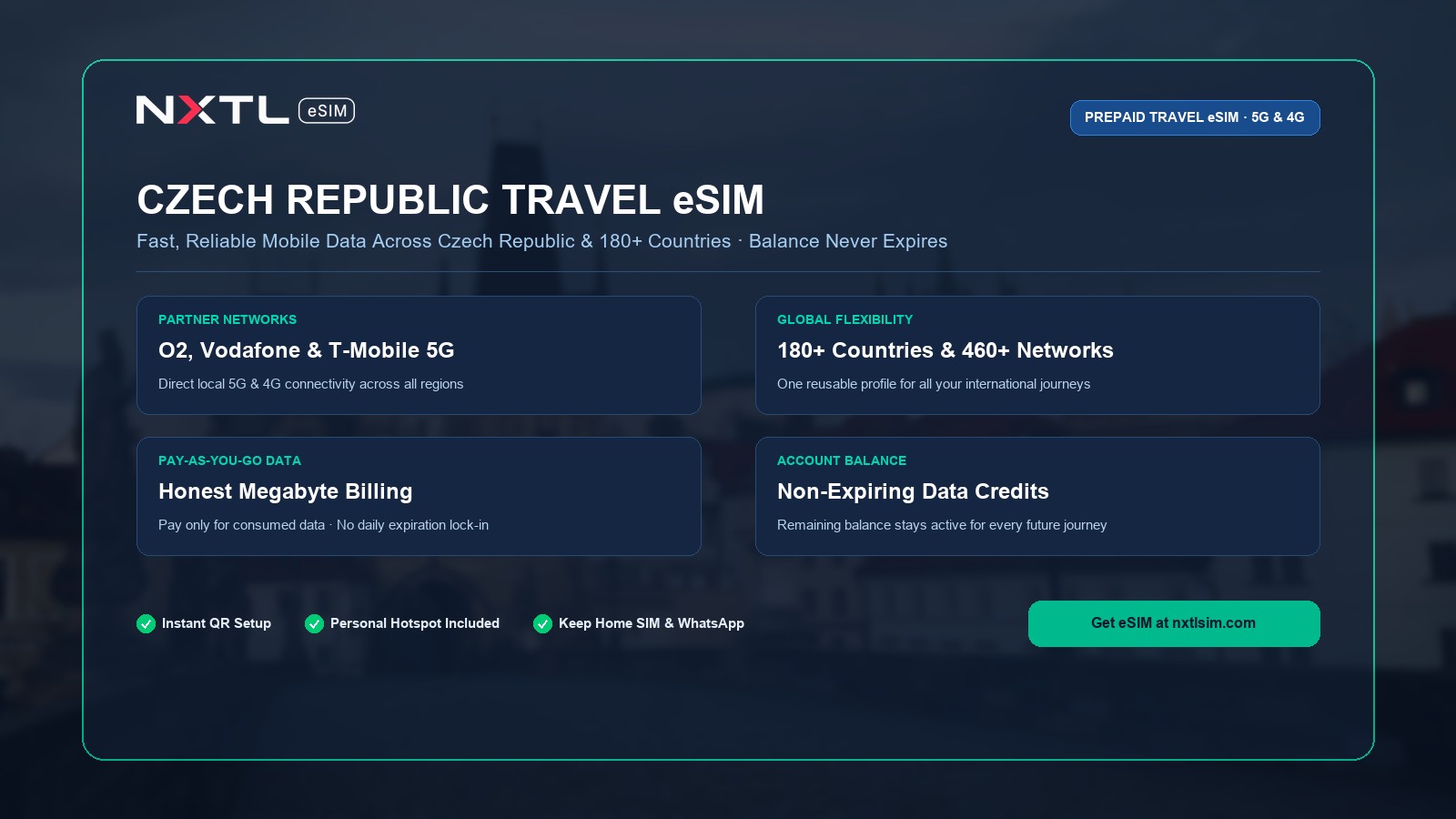
Rather than searching for local phone shops upon arrival or juggling temporary physical SIM cards, set up an eSIM prior to departure. The NXTL Czech Republic eSIM provides high-speed 5G/LTE mobile connectivity powered directly by the country’s leading national telecommunications operators—including O2, Vodafone, and T-Mobile. Starting from just $0.75 per gigabyte, NXTL utilizes a pure pay-as-you-go model where you only pay for the exact megabytes you consume. Unlike typical tourist SIM cards that expire after a week or two, NXTL data credits never expire. Any remaining balance remains stored safely in your account, ready to activate automatically across more than 180 countries on your future travels.
Travel Scams and Consumer Pitfalls to Avoid
The Czech Republic is one of the safest nations in the world, with very low rates of violent crime. However, tourists in high-traffic zones should remain vigilant against several well-documented consumer traps:
- Street Money Exchange Scams: In central Prague, men loitering near licensed exchange offices approach tourists offering enticing exchange rates for euros or dollars. They hand over wads of obsolete Belarusian rubles or Hungarian forints that look similar to Czech korunas but have virtually zero monetary value. Never exchange money on the street; use official bank ATMs or reputable kiosks like Honest Exchange.
- Euronet ATM Dynamic Currency Conversion (DCC): Bright blue-and-yellow independent ATMs (frequently Euronet) are placed throughout Prague and Český Krumlov. These machines use deceptive screen prompts to push “conversion with guarantee,” charging inflated markups of 12% to 18% over the interbank exchange rate. Always select “Without Conversion” or withdraw cash exclusively from official Czech commercial bank ATMs (such as Česká spořitelna, ČSOB, or Komerční banka).
- Rogue Taxi Overcharging: Hailing an unmarked taxi on the street in central Prague or outside the Main Railway Station often results in rigged meters charging four to five times the legal municipal rate. Always book taxis through established digital apps (Liftago, Bolt, or Uber) or agree on a fixed rate from an official station taxi dispatcher.
- Restaurant Bread and Surcharge Traps: In high-tourist restaurants in Old Town Prague and Český Krumlov, waiters occasionally place baskets of pretzels or bread on your table unrequested, only to add substantial per-item charges to the final bill. Examine your itemized bill carefully before paying, and remember that tipping is voluntary, though rounding up 5% to 10% for good service is standard.
- Fake Metro and Tram Ticket Inspectors: Impostors claiming to be transport controllers occasionally target tourists on Prague public transit, flashing fake badges and demanding cash fines for imaginary ticket infractions. Legitimate PID controllers always carry an official metallic badge with a registration number and will issue an official printed receipt for any penalty paid.
By connecting Prague’s Gothic majesty with the quiet charm of South Bohemia by train, staying overnight to experience medieval towns without crowds, and keeping dependable digital connectivity at your fingertips, your journey through Bohemia will remain an authentic, enriching European travel experience.